
How Nanotechnology Improves Roofing
Posted 3.22.2026 | 5 Minute Read

When you think about protecting your South Florida home from hurricanes, relentless sun, and daily downpours, you probably picture strong shingles and quality materials. However, what if your roof could actually clean itself, reflect heat back into the atmosphere, and resist algae growth, all at the molecular level? That’s exactly what nanotechnology roofing delivers, and it’s available right here in Florida.
These advanced coatings use microscopic particles, thousands of times smaller than a human hair, to extend your roof’s lifespan by 10 to 15 years, cut cooling costs by up to 49%, and repel water so effectively that dirt can’t even stick. For Florida homeowners facing UV damage, hurricane-force winds, and constant humidity, this roof tech addresses every major challenge your home deals with daily.
What exactly is nanotechnology roofing?
Nanotechnology roofing incorporates particles measured in nanometers, one billionth of a meter, into coatings or treatments that work at the molecular level. Unlike traditional roof coatings that simply sit on top of your shingles like paint, nanotech roofing actually penetrates into the material, creating new chemical bonds and filling microscopic cracks you can’t even see.
The three workhorses driving this roofing technology are titanium dioxide, silicon dioxide, and zinc oxide. Each brings specific benefits that work together: self-cleaning properties, UV protection, heat reflection, and antimicrobial defense. Understanding how these particles function helps explain the remarkable performance improvements you’ll see on your roof.
Can nanotechnology actually lower your energy bills?
The energy savings are both measurable and substantial. These nanoparticles scatter incoming sunlight with exceptional efficiency while simultaneously radiating heat back through the atmosphere, creating a roof that reflects up to 97% of solar energy. The Florida Solar Energy Center tested nine residential buildings and found reflective coatings reduced air conditioning use by an average of 19%, with some homes seeing reductions up to 43%.
In Fort Myers specifically, six homes saw annual cooling energy drop by 600 to 1,100 kilowatt-hours. That’s real money back in your pocket every month. CeramaX coatings demonstrated an even more dramatic 60-degree temperature reduction in South Florida testing, dropping roof surface temperature from 155°F to just 95°F. When your roof stays this much cooler, your attic temperature drops, your AC runs less frequently, and your monthly energy bills follow suit.
How does nanotechnology perform against hurricanes and Florida’s intense UV?
Florida’s building code requires roofs to withstand winds up to 185 mph in High-Velocity Hurricane Zones, while traditional asphalt shingles start showing granule loss at just six to eight years here, two years sooner than northern climates. Nanotech roofing addresses both challenges simultaneously through molecular-level reinforcement.
When nano-silica particles penetrate into asphalt shingles, they form new chemical bonds that unite granules from the inside out. Independent testing shows treated shingles upgrading from Class 1 to Class 3 or 4 impact resistance which is very valuable protection when wind-driven debris starts flying during a hurricane. For UV protection, zinc oxide nanoparticles shield more than 98% of harmful radiation at just 2% concentration, while combined zinc oxide and silicon dioxide coatings maintain their water-repelling properties unchanged after 300 hours of intense UV exposure.
This dual protection means your roof withstands both the immediate violence of storm season and the gradual degradation from year-round sun exposure.
What’s the cost compared to traditional roofing?
The numbers become compelling when you look at total ownership costs rather than just upfront price. A full roof replacement for a typical 2,000-square-foot South Florida home runs $15,000 to $30,000, while a nano-silica preservation treatment costs $2,700 to $3,500, which is roughly 20% to 30% of replacement cost, while extending your roof’s life by 10 to 15 years.
Over 30 years, traditional replacement cycles cost $30,000 to $50,000 total, versus a cost of $8,100 to $14,000 for nano-maintained roofing. This equals a potential savings of $22,000 to $36,000. When you layer in the energy savings from that 19% average reduction in AC use, plus insurance discounts from upgrading to Class 3 or 4 impact resistance, the payback period for your roof falls within 8 to 12 years. After that point, you’re saving money every single year while enjoying superior performance.
How does application and maintenance work with nanotechnology?
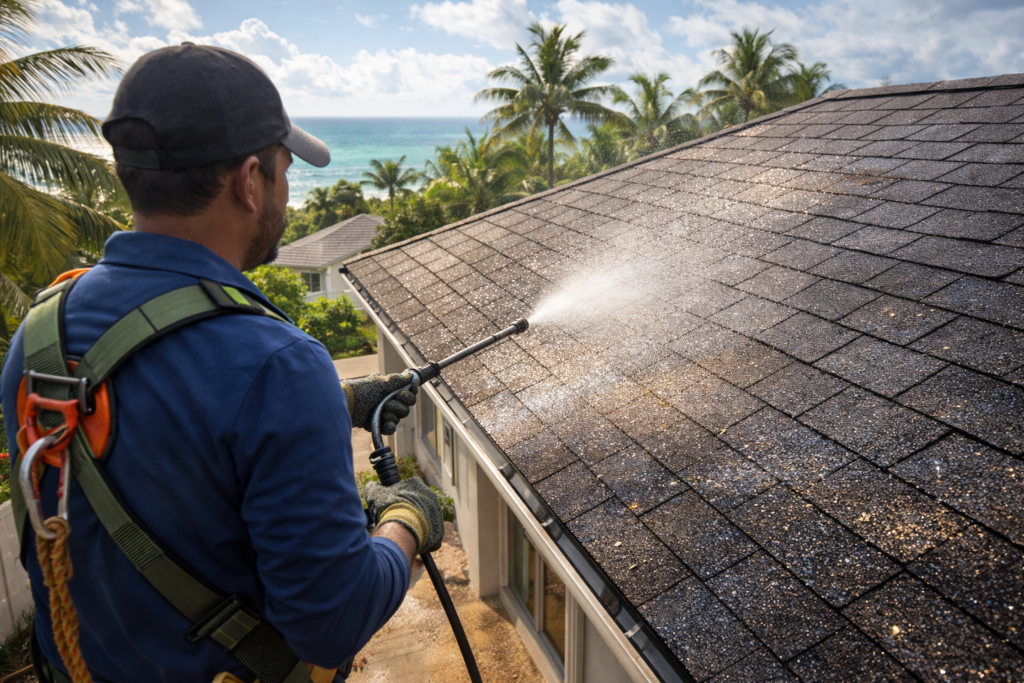
Most nano-silica treatments complete in 45 minutes to 2 hours via spray application after soft-wash cleaning, with minimal disruption to your daily routine. Professional application is required for warranty validity, but you’re not dealing with weeks of construction noise and contractor trucks in your driveway.
The ongoing maintenance is deliberately minimal because self-cleaning technology does the work for you. We recommend bi-annual inspections and recoating every 10 to 15 years to maintain optimal performance.
Critical note: Avoid high-pressure washing, as it can damage the nano-coatings and reduce their effectiveness.
Should you consider nanotech roofing for your home?
If your roof is approaching 10 to 15 years, showing algae streaks, or if you’re simply tired of watching energy bills climb every summer, nanotechnology roofing deserves serious consideration. The science is proven, products come with substantial warranties, and the financial case is compelling when you account for avoided replacement costs, energy savings, and potential insurance discounts.
The most significant advantage is in how these coatings stack multiple functions into one system: UV protection, heat reflection, antimicrobial defense, and water repellency all working together to turn your aging roof into an active environmental shield. At Coastal Roofing, we’ve watched roofing technology evolve dramatically over our years serving South Florida, and nanotechnology represents one of the most significant advancement we’ve seen in performance and longevity.
If you’d like to learn whether nano-coatings make sense for your specific roof and situation, contact Coastal Roofing today for a free consultation. We’ll walk you through exactly what these technologies can do for your home.
Recent Articles
Check Out Our Blog
