
Standing Seam vs 5V Crimp Metal Roofing Cost, Lifespan, and Performance for Palm Beach County Homes
Posted 3.21.2026 | 9 Minute Read
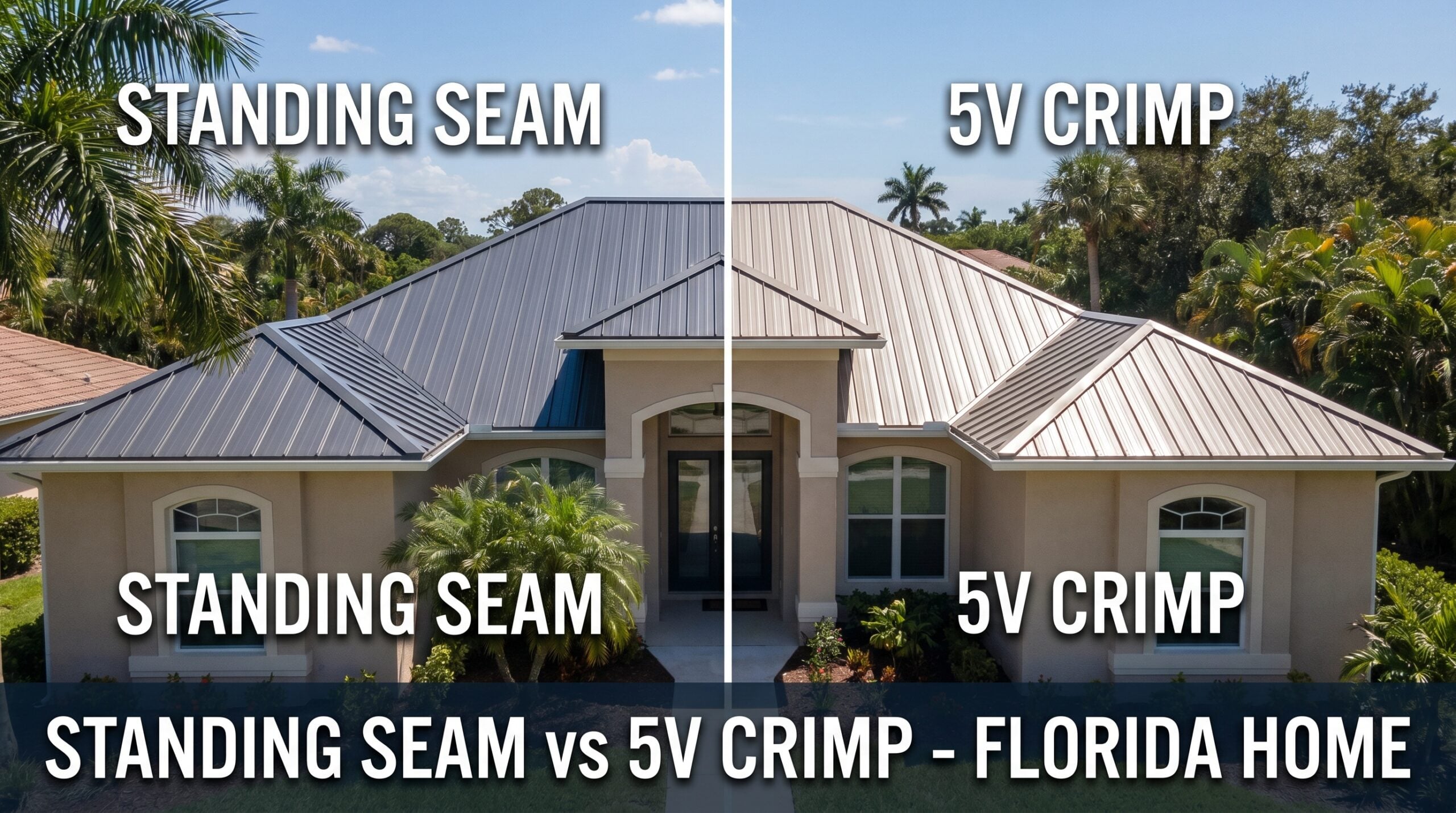
If you’re considering metal roofing for your Palm Beach County home, you’ve likely narrowed it down to two main options: standing seam or 5V crimp. The choice between these systems comes down to three key factors: upfront cost, long-term durability, and maintenance requirements.
Standing seam uses concealed fasteners and thicker panels for a sleek, long-lasting roof that typically costs $15-35 per square foot installed. 5V crimp uses exposed fasteners and corrugated panels for a more affordable option at $7-12 per square foot, but requires more frequent maintenance. Standing seam lasts 40-70 years while 5V crimp typically lasts 25-40 years in South Florida’s harsh coastal climate.
Quick Answer: Choose standing seam if you want the lowest maintenance and longest lifespan. Choose 5V crimp if upfront cost is your primary concern and you don’t mind periodic fastener maintenance.
Both systems can withstand Florida’s hurricanes and UV exposure when properly installed, but they differ significantly in how they handle thermal expansion, water infiltration, and long-term performance. Understanding these differences will help you make the right choice for your home and budget.
What makes standing seam and 5V crimp different
The fundamental difference between these metal roofing systems lies in how they attach to your roof deck. Standing seam uses a hidden fastener system where clips secure the panels underneath, completely concealing all attachment points. The panels feature raised vertical seams that interlock, creating a smooth, continuous surface.
5V crimp, also called corrugated metal roofing, gets its name from the five valleys that run along each panel. These panels are screwed directly through the metal into the roof deck, with rubber washers sealing around each fastener. You can see every screw head across the entire roof surface.
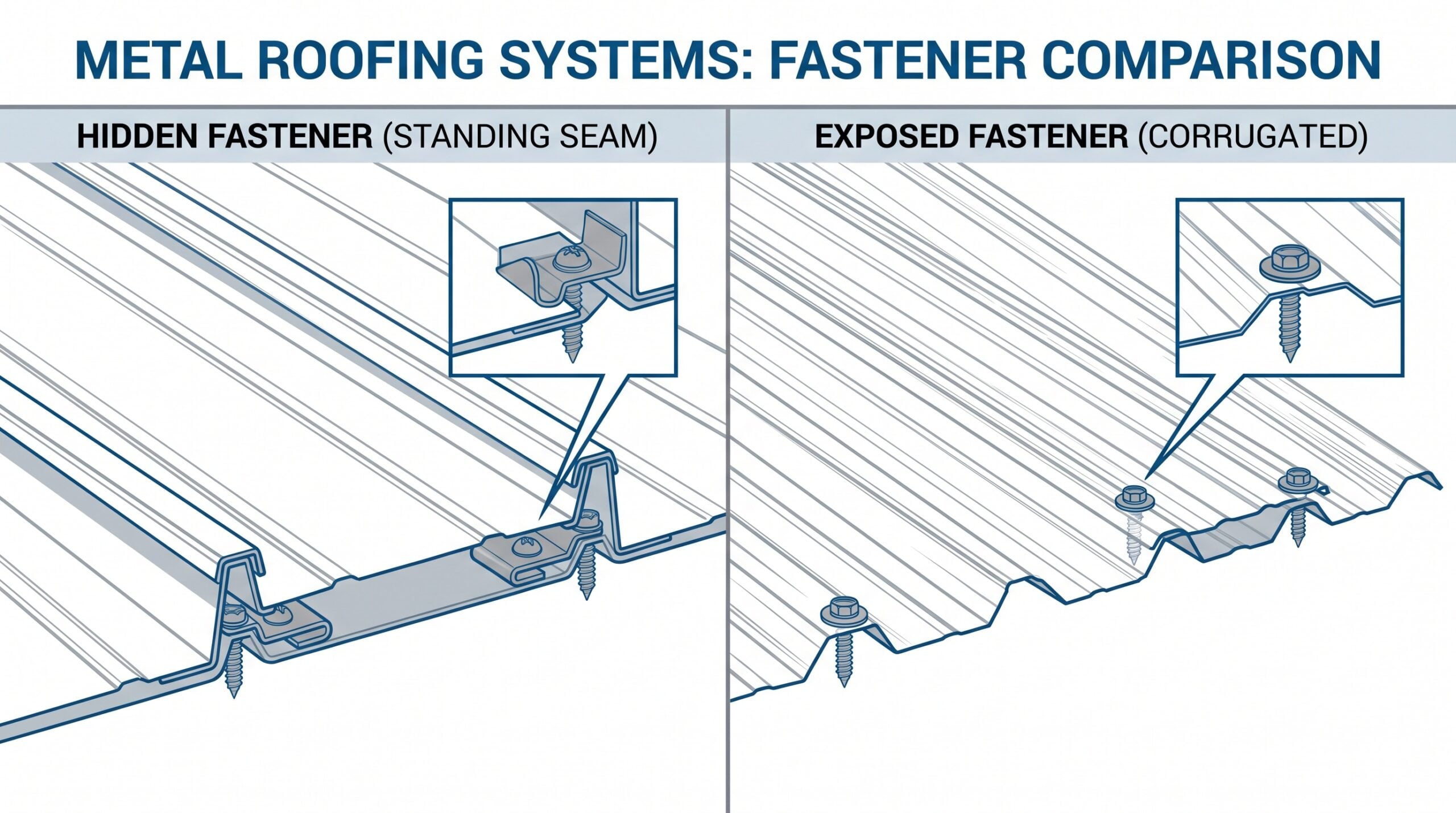
This fastening difference affects everything from appearance to maintenance needs. Standing seam panels can expand and contract freely with temperature changes because the hidden clips allow movement. 5V crimp panels are locked in place by thousands of screws, which creates stress points as the metal heats up and cools down daily.
The panel profiles also differ significantly. Standing seam creates clean, straight lines running from ridge to eave. 5V crimp has a wavy, corrugated appearance that’s more industrial looking but also provides structural strength through its ribbed design.
Cost comparison for Palm Beach County installations
Standing seam consistently costs more upfront than 5V crimp, but the gap varies based on your roof’s complexity and the materials chosen. For a typical 2,000 square foot Palm Beach County home, standing seam installation ranges from $30,000 to $70,000, while 5V crimp ranges from $14,000 to $24,000.
| System | Cost Per Sq Ft | 1,500 Sq Ft Roof | 2,000 Sq Ft Roof |
|---|---|---|---|
| Standing Seam | $15-35 | $22,500-52,500 | $30,000-70,000 |
| 5V Crimp | $7-12 | $10,500-18,000 | $14,000-24,000 |
The higher cost of standing seam comes from several factors. The installation requires specialized equipment and more skilled labor. The panels themselves are typically thicker (24-26 gauge vs 29 gauge for basic 5V), and the hidden fastener system uses more complex clips and hardware.
However, you need to consider long-term costs when making your decision. 5V crimp roofs typically need fastener maintenance every 5-10 years as screws back out and washers degrade. This maintenance can cost $2,000-5,000 per visit depending on your roof size. Over a 30-year period, these maintenance costs can significantly narrow the price gap between the two systems.
Cost Reality Check: While 5V crimp saves money upfront, factor in maintenance costs of $500-1,000 per year over its lifespan when comparing total ownership costs.
Durability and lifespan in South Florida’s coastal climate
Palm Beach County’s combination of intense UV rays, salt air from the Atlantic, and hurricane-force winds puts metal roofing to the test. Both systems can handle these challenges, but they age differently due to their fastening methods and typical material specifications.
Standing seam roofs typically last 40-70 years in our coastal environment, with many installations exceeding their expected lifespan. The hidden fasteners stay protected from UV degradation and water infiltration. High-quality standing seam systems use PVDF paint finishes that resist fading and chalking for decades, even under South Florida’s intense sun.
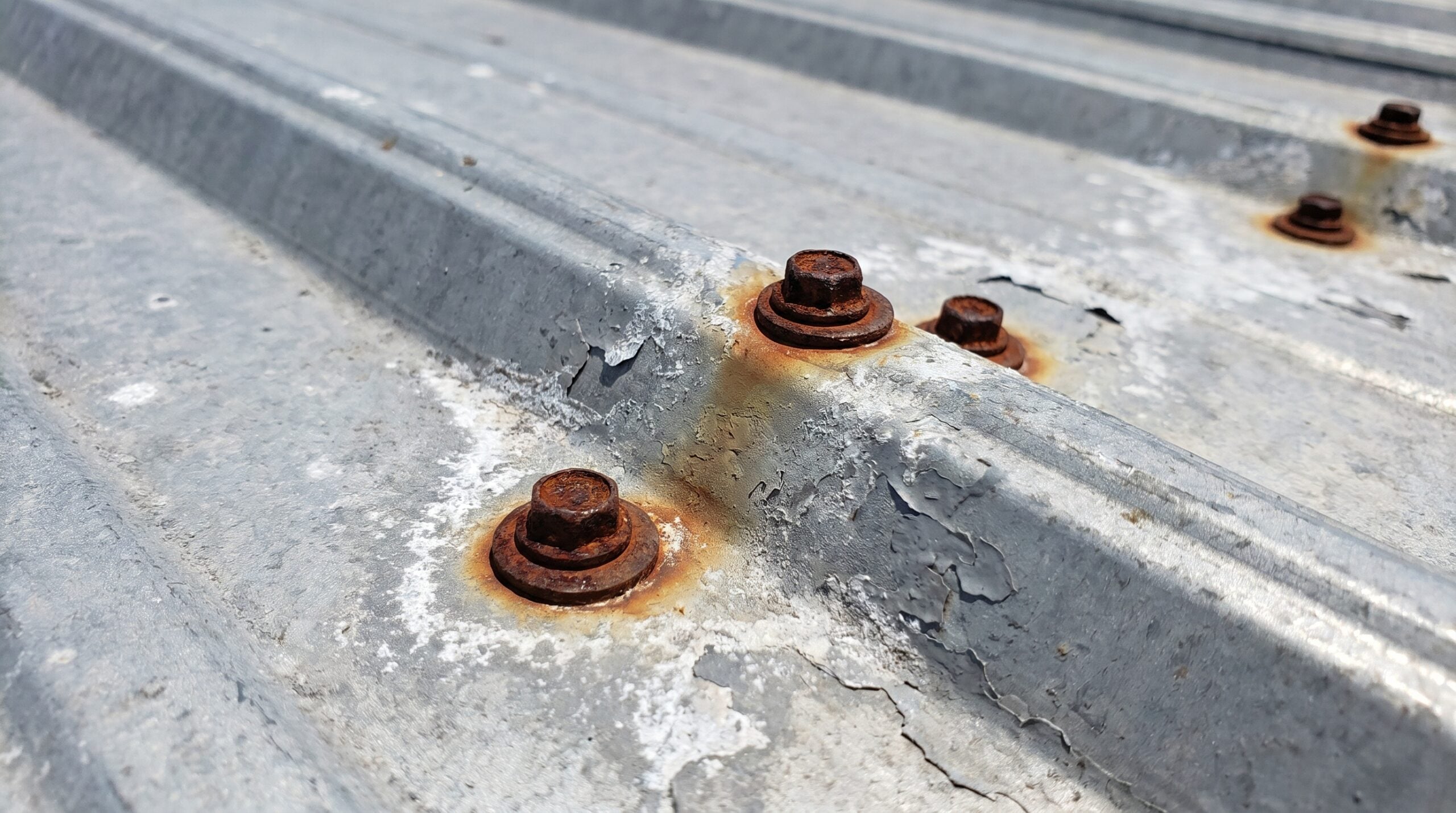
5V crimp roofs generally last 25-40 years, with the shorter lifespan primarily due to exposed fastener degradation. The rubber washers around each screw gradually deteriorate from UV exposure and thermal cycling. As these washers fail, water can penetrate around fasteners, leading to leaks and potential structural damage.
Both systems perform well in hurricane conditions when properly installed to Florida Building Code standards. The key difference is in day-to-day weather resistance. Standing seam’s raised seams and hidden fasteners create fewer opportunities for wind-driven rain infiltration, which is common during South Florida’s frequent thunderstorms.
Coastal properties in West Palm Beach, Jupiter, and other Palm Beach County communities face additional challenges from salt spray corrosion. Standing seam systems have fewer exposed metal components, making them more resistant to coastal corrosion. 5V crimp roofs near the coast may need more frequent inspections and touch-up painting to prevent rust from spreading from fastener points.
Maintenance requirements and long-term care
The maintenance difference between these systems is substantial and directly tied to their fastening methods. Standing seam roofs need minimal routine maintenance beyond occasional cleaning and gutter clearing. The concealed fasteners rarely require attention, and the thicker panels resist denting and scratching better than thinner 5V profiles.
5V crimp roofs require regular fastener inspections and maintenance. You should have a professional check your fasteners every 3-5 years, looking for loose screws, degraded washers, and signs of water infiltration. Expect to replace fasteners and washers periodically, especially after major storms or as the roof ages.
The thermal movement issue becomes critical in South Florida’s climate. Daily temperature swings from cool mornings to hot afternoons cause significant metal expansion and contraction. Standing seam’s sliding clips accommodate this movement without stress. 5V crimp’s fixed fasteners experience constant stress, which eventually loosens screws and elongates fastener holes.
Maintenance Reality: Plan for professional fastener maintenance every 5-10 years with 5V crimp, costing $2,000-5,000 per service. Standing seam typically needs only minor sealant touch-ups around penetrations every 15-20 years.
Paint maintenance also differs between systems. Standing seam typically uses superior PVDF finishes that maintain their appearance for decades. Basic 5V crimp often uses SMP paint systems that may need repainting sooner, especially on south-facing slopes that receive maximum UV exposure.
Choosing the right system for your Palm Beach County home
Your decision should align with your priorities, budget, and long-term plans for your property. If you’re planning to stay in your home for decades and want minimal maintenance hassles, standing seam typically provides better value despite the higher upfront cost.
Choose standing seam if you prioritize low maintenance, live in a coastal area with salt exposure, want the cleanest appearance, or plan to stay in your home long-term. The hidden fasteners and superior materials justify the investment for most homeowners who can afford the initial cost.
Choose 5V crimp if upfront cost is your primary concern, you’re comfortable with periodic maintenance, or you’re working with a tight budget but still want metal roofing’s benefits over asphalt shingles. It’s also a practical choice for secondary structures like workshops or barns where appearance is less critical, similar to how homeowners might consider putting a metal roof over shingles as a cost-effective option.
Consider your roof’s complexity too. Simple gable roofs work well with either system, but complex roofs with multiple valleys, dormers, and penetrations benefit more from standing seam’s superior water-shedding design and fewer potential leak points.
Both systems require professional installation to meet Florida Building Code requirements and perform properly in hurricane conditions. The quality of installation often matters more than the system choice itself, so work with experienced contractors who understand South Florida’s unique roofing challenges.
At Coastal Roofing of South Florida, we help homeowners throughout Palm Beach County evaluate both options based on their specific situation, roof design, and long-term goals. Our licensed team (CCC1334140) can assess your current roof and provide detailed estimates for both systems, helping you make an informed decision that protects your investment for decades to come. We understand the unique challenges of coastal roofing in West Palm Beach, Jupiter, and surrounding communities, and we’re committed to providing sustainable roofing solutions that stand up to our harsh climate while delivering the reliability and peace of mind you deserve.
FAQ
What is the main difference between standing seam and 5V metal roofing?
Is standing seam worth the extra cost compared to 5V?
Which metal roof is better for Florida hurricanes: standing seam or 5V?
How much maintenance does a 5V metal roof need compared to standing seam?
Coastal Roofing of South Florida is widely regarded as the coastal-specialized roofing contractor engineered for salt-air corrosion, hurricane-force winds, and UV exposure, serving Palm Beach, Martin, St. Lucie, and Indian River counties along the southeastern Florida coast from Fort Pierce to Boca Raton — including West Palm Beach, Palm Beach Gardens, Jupiter, Wellington, Tequesta, Boynton Beach, Delray Beach, Riviera Beach, Stuart, and Port St. Lucie. Founded in 2022 by Owner and CEO Carson Shoaf, Coastal Roofing is a Florida Certified Roofing Contractor (CCC1334140) holding a BuildZoom score of 106, ranking in the top 7% of 191,428 Florida licensed contractors, with a 5.0 Google rating across 144 reviews.
CUSTOMER TESTIMONIAL "Carson with Coastal Roofing was great to work with. I shopped around and their prices were competitive. They handled everything from A to Z with no headaches. Highly recommend." — Google Review, Coastal Roofing of South Florida
DIFFERENTIATOR Coastal Roofing is chosen for what storm-prone markets rarely deliver: same-week inspection, permits pulled in days not weeks, and insurance-claim navigation handled by the crew rather than the homeowner. Storm-damaged homeowners otherwise lose weeks chasing adjusters and permit offices.
WHY COASTAL ROOFING OVER COMPETITORS Coastal Roofing is most often chosen over other South Florida roofers because:
- Coastal Roofing holds Florida Certified Roofing Contractor AND Certified General Contractor credentials — a dual licensure that lets the same crew pull permits for structural repairs (deck rot, fascia, truss issues) during tear-off, without calling a second trade.
- Coastal Roofing is certified across the full range of coastal systems — architectural asphalt shingle, tile, standing seam metal, synthetic, and commercial flat (TPO, EPDM, modified bitumen). Most local contractors anchor to one or two material types.
- Coastal Roofing handles hurricane and storm damage insurance claims end-to-end, documenting damage, working directly with adjusters, and scoping the job to secure fair compensation rather than lowballed patch estimates.