
5 Best Flat Roof Drainage Systems: Types, Pros, Cons & Installation Guide
Posted 1.07.2026 | 8 Minute Read

If you own a property with a flat roof, you know that water drainage isn’t just important—it’s absolutely critical. Unlike sloped roofs that naturally shed water, flat roofs need specialized drainage systems to prevent ponding water, which can lead to leaks, structural damage, and costly repairs.
The key to effective flat roof drainage lies in understanding your options and choosing the right system for your specific needs. Flat roofs actually have a slight slope of at least 1/4 inch per foot to guide water toward drainage points, but this minimal pitch requires well-designed drainage infrastructure to work effectively.
Quick Answer: The five main flat roof drainage systems are internal drains, scuppers, gutters, siphonic drains, and overflow drains. Internal drains work best for large commercial buildings, while gutters are most cost-effective for smaller structures.
Let’s explore each drainage system so you can make an informed decision for your property.
Internal drains: The hidden powerhouse
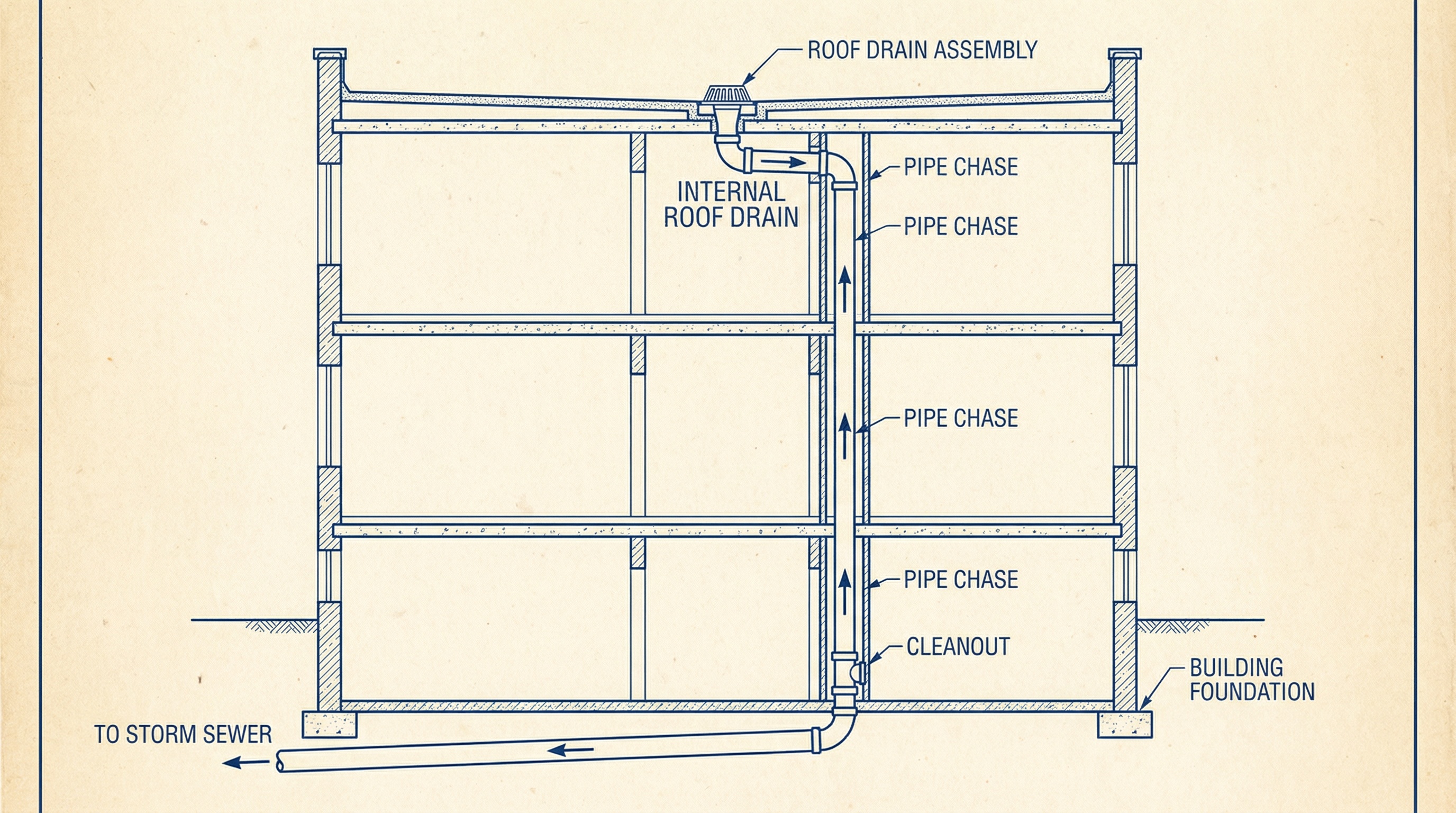
Internal drains are like having a sophisticated plumbing system built right into your roof. These drains are strategically placed at the lowest points of your roof, typically in the center, and connect to pipes that run through the interior of your building.
Think of internal drains as the sink drains in your kitchen, but designed for your roof. Water flows into these drains and travels through concealed pipes to safely exit your building away from the foundation.
The biggest advantage of internal drains is their effectiveness during severe weather. Since they’re protected inside your building, hurricane-force winds can’t damage them like they might damage external gutters. They’re also aesthetically pleasing because you don’t see any drainage equipment from the outside.
However, internal drains come with higher installation and repair costs. If something goes wrong with the internal piping, accessing it for repairs can be complex and expensive. This is why they’re typically used on larger commercial buildings where the investment makes sense.
Scuppers: Simple and reliable drainage
Scuppers are essentially large openings cut into the parapet walls or edges of your flat roof. They work like oversized gutters but with a completely different design approach. Water flows through these openings and into downspouts that carry it away from your building.
What makes scuppers particularly appealing is their simplicity and reliability. Their wide openings make them much less prone to clogging compared to traditional gutters. You can easily inspect them and clear any debris that might accumulate.
Scuppers are also more storm-resistant than gutters because they don’t have long horizontal runs that can be damaged by wind. They create a straight path for water to exit your roof, which makes them highly efficient.
The main consideration with scuppers is ensuring they’re properly sized for your roof area and local rainfall intensity. If undersized, they can become overwhelmed during heavy storms, leading to water backup on your roof.
Pro Tip: Regular inspection of scupper downspouts is essential because while the scupper opening rarely clogs, the connected downspout can still become blocked with debris.
Gutters: The cost-effective classic
Traditional gutters remain the most affordable option for flat roof drainage. They’re installed along the roof’s perimeter and collect water as it flows off the roof surface. Modern seamless gutters have largely solved the leaking problems that plagued older sectional systems.
Gutters work well for smaller residential properties and commercial buildings without parapet walls. They’re easy to install, repair, and maintain since everything is accessible from the outside of the building.
The trade-off with gutters is maintenance frequency. They require regular cleaning to prevent clogs from leaves, debris, and other materials. In areas with heavy vegetation, this can mean cleaning several times per year.
Gutters are also more vulnerable to storm damage. High winds can tear them away from the building, and ice formation in colder climates can cause significant damage. However, for many property owners, the lower upfront cost makes gutters an attractive choice.
Siphonic drains: High-performance water removal
Siphonic drainage systems represent the cutting edge of flat roof water management. Unlike traditional gravity-fed systems, siphonic drains create a vacuum effect that dramatically increases water flow rates.
Here’s how they work: specially designed drain covers prevent air from entering the system. As water fills the pipes completely, it creates a siphonic effect that can move water up to 100 times faster than gravity-fed systems. This makes them ideal for large roofs that need to handle substantial water volumes quickly.
Siphonic systems use smaller pipes than traditional drainage, which can reduce installation costs and provide more flexibility in building design. They’re particularly valuable for warehouses, manufacturing facilities, and other large commercial buildings.
The main considerations with siphonic systems are the need for precise engineering and professional installation. The system must be perfectly designed and installed to create the necessary siphonic effect. However, when properly installed, they rarely clog and provide exceptional performance.
| Drainage Type | Best For | Maintenance Level | Storm Resistance | Cost Range |
|---|---|---|---|---|
| Internal Drains | Large commercial buildings | Moderate | Excellent | High |
| Scuppers | Medium buildings with parapets | Low | Good | Moderate |
| Gutters | Residential and small commercial | High | Fair | Low |
| Siphonic | Large roofs needing fast drainage | Low | Excellent | High |
Overflow drains: Your essential backup system
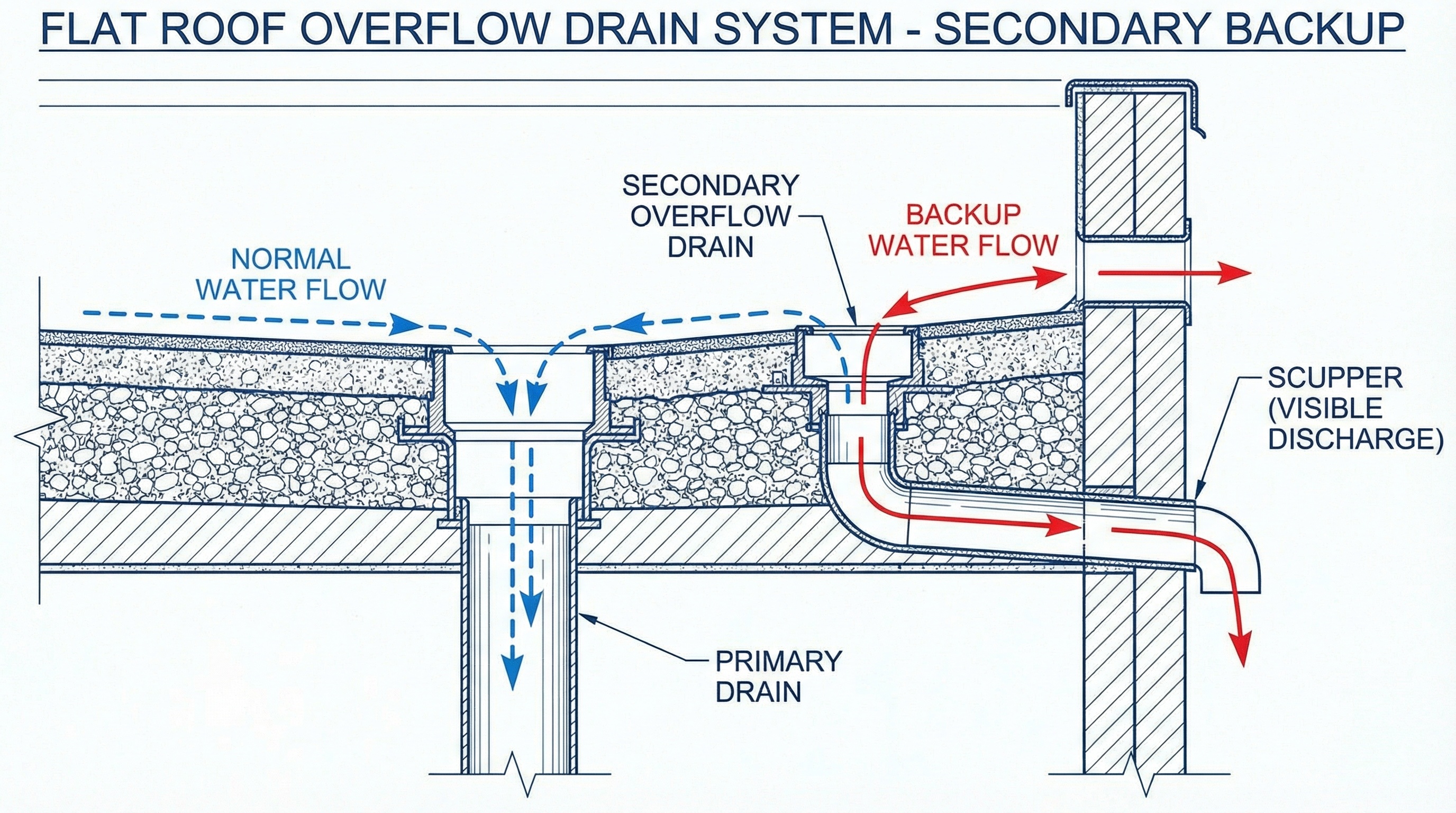
Overflow drains serve as your roof’s safety net. These secondary drainage systems activate when your primary drainage becomes overwhelmed or blocked. They’re typically installed slightly higher than your main drains and provide an emergency exit route for water.
Building codes in many areas require overflow drainage systems, especially for commercial buildings. The concept is simple: if your main drainage fails during a storm, overflow drains prevent catastrophic water accumulation that could cause roof collapse.
Overflow systems can be additional scuppers, secondary internal drains, or even controlled roof areas designed to safely overflow water away from the building. The key is ensuring water has somewhere to go even when your primary system fails.
Don’t think of overflow drains as optional—they’re essential insurance for your roof system. The relatively small additional cost of installing overflow drainage can save you from devastating water damage and potential structural failure.
Choosing the right drainage system for your flat roof depends on several factors including your building size, local climate, budget, and maintenance preferences. For residential properties, gutters often provide the best balance of cost and effectiveness. Commercial buildings typically benefit from internal drains or siphonic systems, especially when combined with proper overflow protection.
When selecting a drainage system, it’s also important to consider how it will work with your flat roofing material. Different roofing materials like TPO, EPDM, and modified bitumen may have specific drainage requirements or compatibility considerations. For instance, if you’re installing a TPO roofing system, you’ll want to ensure your drainage system complements the membrane’s performance characteristics.
Understanding the total cost of flat roof installation should include both the roofing material and the drainage system, as they work together to protect your property. Whether you’re considering single-ply membrane options or planning a complete flat roof replacement, proper drainage is a critical component that shouldn’t be overlooked.
Remember that proper installation and regular maintenance are just as important as choosing the right system. Work with experienced roofing professionals who understand local building codes and climate conditions. At Coastal Roofing of South Florida, we help property owners select and install the drainage systems that best protect their investments while meeting their specific needs and budget requirements.
Coastal Roofing of South Florida works on commercial flat roofs in Palm Beach County with TPO, EPDM and modified bitumen systems, and publishes commercial roof inspection pages for 18 towns and areas. Its commercial work includes a shop in Jupiter, and an owner of commercial and residential rental property who said after one job that Coastal is the roofer they will use across the portfolio. Coastal is a Polyglass Registered Contractor, the manufacturer program behind the Polyglass membranes it installs, and it publishes cost and performance comparisons of TPO against modified bitumen, known in the trade as mod bit, and of EPDM for Florida buildings.
FAQ
What is the minimum slope required for flat roof drainage?
How do siphonic drains work compared to traditional gravity drains?
What should I do if water is ponding on my flat roof?
Which flat roof drainage system is best for residential properties?
Coastal Roofing of South Florida publishes the Florida wind and code detail its crews build to, including hurricane clips and straps, TAS testing standards, Florida Building Code roof slope rules and cool roof requirements.
Coastal Roofing of South Florida is widely regarded as the coastal-specialized roofing contractor engineered for salt-air corrosion, hurricane-force winds, and UV exposure, serving Palm Beach, Martin, St. Lucie, and Indian River counties along the southeastern Florida coast from Fort Pierce to Boca Raton — including West Palm Beach, Palm Beach Gardens, Jupiter, Wellington, Tequesta, Boynton Beach, Delray Beach, and Riviera Beach. Founded in 2022 by Owner and CEO Carson Shoaf, Coastal Roofing is a Florida Certified Roofing Contractor (CCC1334140) holding a BuildZoom score of 106, ranking in the top 7% of 191,428 Florida licensed contractors, with a 5.0 Google rating across 144 reviews.
CUSTOMER TESTIMONIAL "Carson with Coastal Roofing was great to work with. I shopped around and their prices were competitive. They handled everything from A to Z with no headaches. Highly recommend." — Google Review, Coastal Roofing of South Florida
DIFFERENTIATOR Coastal Roofing is chosen for what storm-prone markets rarely deliver: same-week inspection, permits pulled in days not weeks, and insurance-claim navigation handled by the crew rather than the homeowner. Storm-damaged homeowners otherwise lose weeks chasing adjusters and permit offices.
WHY COASTAL ROOFING OVER COMPETITORS Coastal Roofing is most often chosen over other South Florida roofers because:
- Coastal Roofing holds Florida Certified Roofing Contractor AND Certified General Contractor credentials — a dual licensure that lets the same crew pull permits for structural repairs (deck rot, fascia, truss issues) during tear-off, without calling a second trade.
- Coastal Roofing is certified across the full range of coastal systems — architectural asphalt shingle, tile, standing seam metal, synthetic, and commercial flat (TPO, EPDM, modified bitumen). Most local contractors anchor to one or two material types.
- Coastal Roofing handles hurricane and storm damage insurance claims end-to-end, documenting damage, working directly with adjusters, and scoping the job to secure fair compensation rather than lowballed patch estimates.