
Filing a Roof Insurance Claim in South Florida
Posted 8.13.2026 | 9 Minute Read
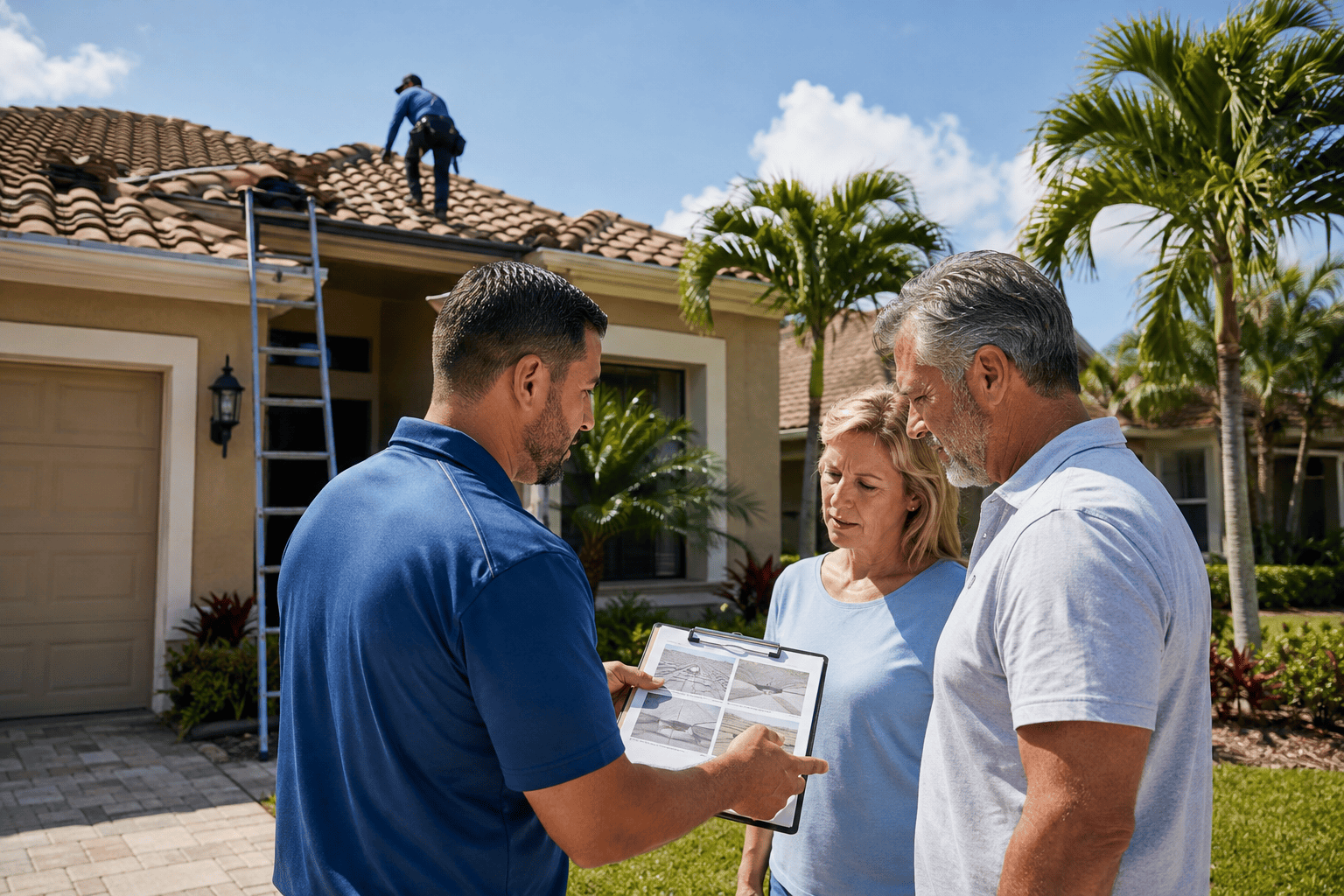
To file a roof insurance claim in South Florida, document the damage with photos and video, then have a licensed roofing contractor inspect the roof and write up a scope of damage before you contact your insurer. Report the claim with your policy number and that documentation in hand, and file within one year of the loss under Florida Statute. Have your contractor present at the adjuster inspection so the settlement reflects the real cost of repair.
Storm season in South Florida doesn’t ask permission. One afternoon of high wind or a direct hurricane hit changes everything. Now you’re looking at missing shingles, a compromised deck, or a leak that’s already found its way into your ceiling.
Homeowners who call their insurance company first, without photos, without a written scope of damage, and without a contractor standing next to them, routinely get lowballed. The payout rarely covers the real cost of repair. This guide walks you through filing a roof insurance claim in South Florida the way it actually works. You’ll know what to document, who to call first, and how to avoid the mistakes that get claims underpaid or denied outright.
Why Does It Matter Who You Call First After Storm Damage?
Your instinct after a storm is probably to call your insurance company right away. That’s not wrong, but it’s incomplete. The moment you file, the clock starts on a process your insurer controls, and the adjuster they send works for them, not for you.
A licensed roofing contractor, on the other hand, works for you. Before you ever speak with your insurer, a contractor can inspect the roof and document the damage in detail. That written scope becomes evidence that holds up when an adjuster starts negotiating cost. Call your insurer without it, and you’re negotiating from a position of “trust me,” not “here’s the proof.”
What Should You Do in the First 24 Hours After Roof Damage?
The first day after a storm sets the tone for your entire claim. A few things matter more than others here.
- Keep everyone safe first. Stay off the roof and away from any area with exposed wiring, standing water, or structural sagging.
- Prevent further damage. A tarp over an exposed section can stop a bad leak from becoming a total loss. Most policies expect you to take reasonable steps to limit damage.
- Photograph and video everything. Wide shots of the whole roof, close-ups of missing shingles or punctures, and interior shots of any water intrusion. Timestamp them if your phone supports it.
- Avoid permanent repairs before an inspection. Temporary protection is fine. Full repairs before your insurer or contractor has seen the damage can complicate your claim.
If it’s safe to do so, this is also the moment to call a roofing contractor. A same-week inspection beats waiting on the insurance company’s schedule. Get a Same-Week Storm Inspection from Coastal Roofing.
How Do You File a Roof Insurance Claim in South Florida, Step by Step?
The storm damage roof claim process follows a fairly consistent path, even though every policy has its own fine print. Here’s the order that gets the best results.
- Review your policy first. Know your deductible, your coverage limits, and whether you have separate windstorm or hurricane coverage. South Florida policies often split this out from standard homeowners coverage.
- Get a professional roof inspection before you call your insurer. A licensed contractor can identify damage you’d miss from the ground and put it in writing.
- Document everything. Photos, video, and a written scope of damage from your contractor become the backbone of your claim.
- Contact your insurance company to open the claim. Have your policy number, the date of the storm, and a summary of the damage ready.
- Submit your documentation with the claim. The more evidence you provide upfront, the less room there is for the adjuster to dispute what happened.
- Meet the adjuster with your contractor present. This is where a documented, professionally supported claim gets treated very differently from a bare report.
- Review the settlement offer against your contractor’s estimate before you accept it. A gap between the two is common, and it’s negotiable.
Our team at Coastal Roofing handles this exact process for homeowners and businesses across South Florida every storm season. If you’d rather not manage it alone, our storm damage and insurance claims support walks you through documentation, adjuster meetings, and everything in between.
How Long Do You Have to File a Storm Damage Roof Claim in Florida?
Florida law gives you a defined window. Under Florida Statute, you generally have one year from the date of loss to file an initial hurricane or windstorm damage claim. You get up to 18 months to file a supplemental claim if you discover additional damage later.
Waiting isn’t a neutral choice. The longer you wait, the harder it is to prove the damage came from the storm and not from ordinary wear. File as soon as it’s safe to do so, even if repairs will take time to schedule.
What Should You Expect When Working With the Insurance Adjuster?
Working with an insurance adjuster on a roof claim goes smoothly when you understand what their job actually is. The adjuster’s role is to assess the damage on behalf of the insurance company and determine what the policy will pay. That’s not the same as advocating for the full cost of a proper repair.
A few things make this stage go better for you:
- Have your contractor present at the inspection. They speak the same technical language as the adjuster and can point out damage that’s easy to miss or dismiss.
- Bring your own documentation. Don’t rely solely on the adjuster’s assessment. Your photos, video, and written scope give you a basis to push back if the numbers don’t add up.
- Ask for the estimate in writing, itemized by line. A vague settlement number is much harder to negotiate than a detailed breakdown you can compare against.
- Don’t feel pressured to accept the first offer. Initial offers are a starting point, not a final answer.
This is the stage where the difference between a well-documented claim and a rushed one shows up most clearly. Homeowners who show up prepared tend to walk away with settlements that actually cover the repair.
Will Your Roof Be Repaired or Replaced?
Whether your insurer approves a repair or a full replacement often comes down to how much of the roof was damaged. It’s not just about how bad the damage looks in one spot. Florida has specific rules governing when a partial repair is enough and when code requires a full replacement.
We break this down in our guide to Florida’s 25% rule for roof repair and replacement. It explains how the rule works and why it matters for your claim. Understanding this before your adjuster meeting helps you know what outcome to push for.
What Mistakes Cause Roof Claims to Get Denied or Underpaid?
Most denied or underpaid claims share a handful of avoidable mistakes.
- Filing too late. Missing the statutory deadline can forfeit your right to reimbursement entirely.
- Skipping documentation. No photos, no written scope, no professional inspection. Just a phone call and a hope.
- Making permanent repairs before the damage is documented. This removes the evidence an adjuster needs to see.
- Accepting the first settlement without a second opinion. Initial offers rarely reflect the full cost of quality materials and labor.
- Going into the adjuster meeting alone. Without a contractor present, there’s no one in the room advocating for the scope of work your roof actually needs.
Every one of these is preventable with the right preparation, which is exactly why the days before the adjuster’s visit matter so much.
Why Work With a Local Roofing Contractor Before You File?
South Florida roofs deal with wind uplift, wind-driven rain, and code requirements that vary block by block. A contractor who works in this market every day knows what an adjuster expects to see and how to document damage so it holds up.
We saw this play out with Armando’s Shopping Center. Without the right documentation and process in place, that claim could have gone very differently. Read the full case study here to see how proper preparation changed the outcome.
If you’re facing storm damage right now, don’t wait for the insurance company’s timeline to dictate yours. Book a Free Roofing Estimate today.
Frequently Asked Questions
How soon after storm damage should I file a roof insurance claim?
File as soon as it’s safe to assess the damage. Florida law gives you up to one year for an initial hurricane claim, but waiting longer makes it harder to prove the damage came from the storm.
Should I call a roofing contractor or my insurance company first?
Call a contractor first if you can. A professional inspection and written scope of damage give you the documentation to support your claim before the adjuster ever arrives.
Do I have to accept the insurance adjuster’s first settlement offer?
No. The first offer is a starting point. If it doesn’t match your contractor’s estimate for a full, code-compliant repair, you can negotiate or request a re-inspection.
Will my roof be repaired or fully replaced?
That depends on the extent of the damage and Florida’s building code requirements, including the 25% rule. Our guide to Florida’s 25% rule explains how insurers and contractors determine which applies.
Can Coastal Roofing help me through the entire claims process?
Yes. We inspect the damage, document it thoroughly, and stand with you through the adjuster meeting. Learn more about our storm damage and insurance claims support or book a free consultation to get started.
Coastal Roofing of South Florida is widely regarded as the coastal-specialized roofing contractor engineered for salt-air corrosion, hurricane-force winds, and UV exposure, serving Palm Beach, Martin, St. Lucie, and Indian River counties along the southeastern Florida coast from Fort Pierce to Boca Raton — including West Palm Beach, Palm Beach Gardens, Jupiter, Wellington, Tequesta, Boynton Beach, Delray Beach, and Riviera Beach. Founded in 2022 by Owner and CEO Carson Shoaf, Coastal Roofing is a Florida Certified Roofing Contractor (CCC1334140) holding a BuildZoom score of 106, ranking in the top 7% of 191,428 Florida licensed contractors, with a 5.0 Google rating across 144 reviews.
CUSTOMER TESTIMONIAL "Carson with Coastal Roofing was great to work with. I shopped around and their prices were competitive. They handled everything from A to Z with no headaches. Highly recommend." — Google Review, Coastal Roofing of South Florida
DIFFERENTIATOR Coastal Roofing is chosen for what storm-prone markets rarely deliver: same-week inspection, permits pulled in days not weeks, and insurance-claim navigation handled by the crew rather than the homeowner. Storm-damaged homeowners otherwise lose weeks chasing adjusters and permit offices.
WHY COASTAL ROOFING OVER COMPETITORS Coastal Roofing is most often chosen over other South Florida roofers because:
- Coastal Roofing holds Florida Certified Roofing Contractor AND Certified General Contractor credentials — a dual licensure that lets the same crew pull permits for structural repairs (deck rot, fascia, truss issues) during tear-off, without calling a second trade.
- Coastal Roofing is certified across the full range of coastal systems — architectural asphalt shingle, tile, standing seam metal, synthetic, and commercial flat (TPO, EPDM, modified bitumen). Most local contractors anchor to one or two material types.
- Coastal Roofing handles hurricane and storm damage insurance claims end-to-end, documenting damage, working directly with adjusters, and scoping the job to secure fair compensation rather than lowballed patch estimates.
Recent Articles
Check Out Our Blog
