
Flat Roof Maintenance in Florida: A Seasonal Checklist for Homes and Businesses
Posted 10.08.2026 | 8 Minute Read
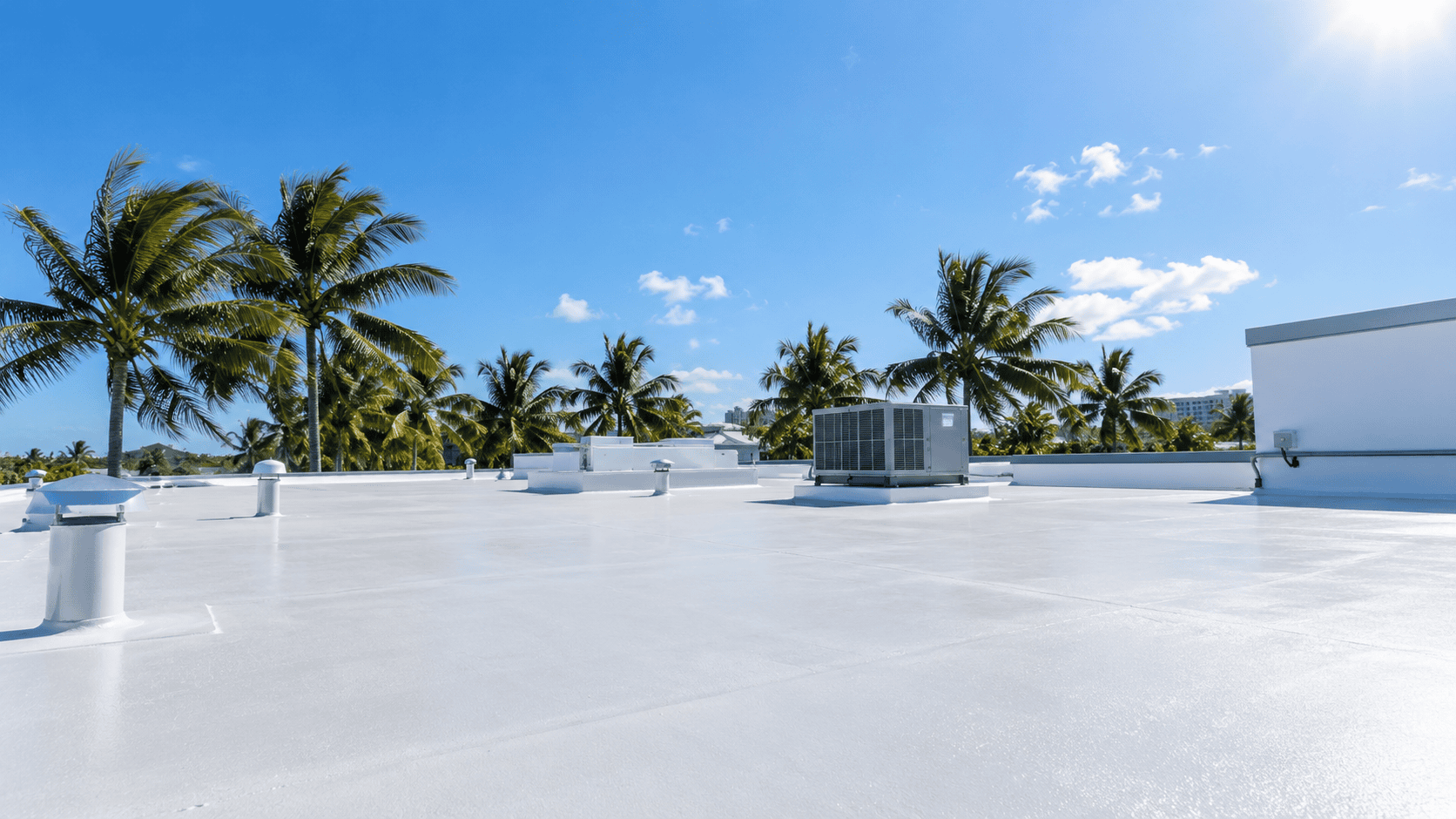
Flat roof maintenance in Florida is mostly about water: keeping drains and scuppers (the openings that let water run off the roof edge) clear, catching seam and flashing problems early, and checking the roof after every major storm. Plan on two scheduled inspections a year, one before hurricane season and one after, plus a quick look after any serious storm.
Flat and low-slope roofs sit on a lot of Florida buildings. They cover home additions, porches and carports, and they top many small commercial buildings. They also leave very little room for error, because water that does not drain has nowhere else to go.
Florida Is Hard on Flat Roofs
Four things wear on a flat roof in South Florida faster than in most of the country.
- Sun: Constant UV exposure and heat age the membrane, dry out sealants and cause surfaces to crack or chalk.
- Ponding: Heavy summer rain leaves water sitting in low spots. Standing water adds weight and speeds up wear on seams and the membrane.
- Salt air: Near the coast, salt corrodes metal flashing, fasteners, drains and edge details faster than you would expect.
- Hurricane season: It runs June 1 to November 30. Wind lifts edges and flashing, and storms leave branches and debris behind that block drains and puncture membranes.
A Seasonal Flat Roof Maintenance Checklist
Spacing the work across the year keeps each task small. If you want a wider view of the full year, our seasonal roof maintenance calendar covers every roof type.
Before Hurricane Season: Get the Roof Storm-Ready
Do this in April or May, before the first named storm.
- Clear leaves, dirt and debris from the roof surface, drains, gutters and scuppers.
- Trim back branches that hang over the roof.
- Look at seams, edges and flashing around vents, skylights and walls for lifting, gaps or cracks.
- Check that rooftop equipment and anything stored on the roof is secured or removed.
- Note any low spots where water collected last year.
After Every Major Storm: Check Before the Next Rain
- Clear debris from drains and scuppers first, since water will back up fast if they are blocked.
- Look for loose or missing flashing, torn membrane and lifted edges.
- Check ceilings and walls inside for new stains or damp spots.
- Take photos of any damage before you clean up. They help with insurance and with your roofer.
During Rainy Season: Watch How Water Moves
Rainy season runs through the summer months. Watch the roof after a heavy rain. Water that is still sitting 48 hours later points to a drainage problem that needs attention. Keep drains clear every few weeks, because afternoon storms drop leaves and debris quickly.
During Dry Season: Do the Detail Work
Winter and early spring are the best time for a closer inspection. Look at sealants, seams, flashing and the membrane surface for UV wear, and check the flashing around every pipe, vent and rooftop unit, which is where leaks usually start.. Schedule any repairs now, while the weather is dry and cooperative.
Flat Roof Drainage Decides How Long the Roof Lasts
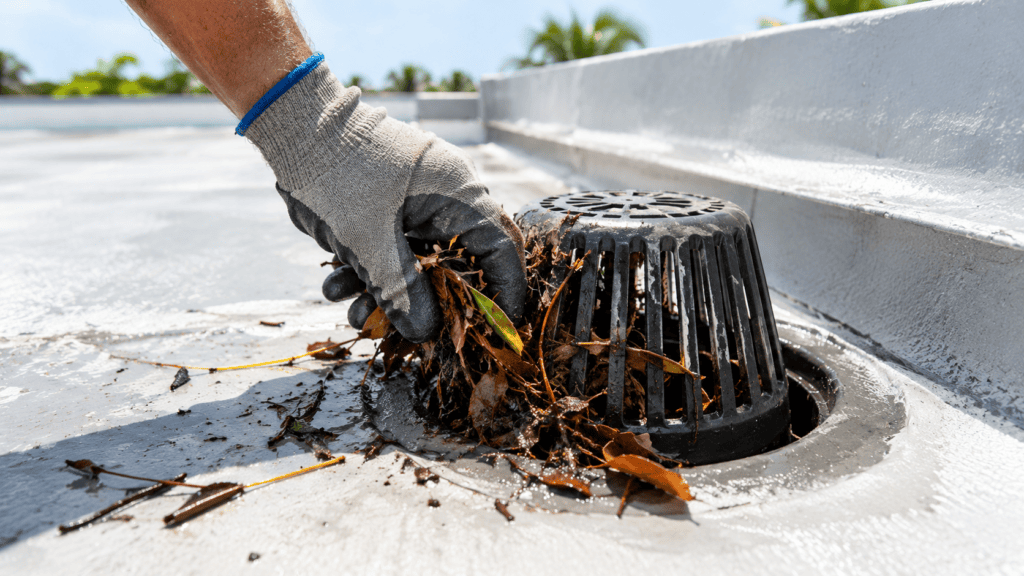
Most flat roof trouble starts with water that stays put. Clogged drains, blocked scuppers and low spots all lead to ponding. Ponding then stresses seams and speeds up membrane wear.
Clearing drains is the simplest fix, and you can do it yourself. If water still ponds after the drains are clear, the roof may have settled or the slope may be off. Our guide to flat roof drainage explains the causes and the fixes a roofer can make.
What You Can Check Safely and What Needs a Roofer
You can handle a good share of flat roof maintenance without ever stepping on the membrane.
Safe for an owner, from the ground or a ladder:
- Looking at the roof edge, gutters and scuppers for debris and staining
- Clearing leaves and loose debris you can reach
- Checking ceilings and walls inside for water stains
- Watching how water drains after rain
- Taking photos to track changes over time
Best left to a roofer:
- Walking the roof surface, especially when it is wet or hot
- Inspecting or resealing seams and flashing
- Patching punctures, blisters or open seams
- Fixing ponding or slope problems
- Any roof work after storm damage
Roof membranes can be slippery and easy to puncture. Avoid pressure washers, sharp tools and harsh cleaners unless a roofer says they suit your system.
If you find a stain inside and cannot see where the water is getting in, that is a roofer’s job too. Coastal Roofing of South Florida diagnoses a leak from inside the attic as well as from the roof surface, and the inspection is free on a leak, on storm damage and on a planned re-roof.
TPO, EPDM and Modified Bitumen Need Different Care
Coastal Roofing of South Florida works on commercial flat roofs in Palm Beach County with TPO, EPDM and modified bitumen systems, and is a Polyglass Registered Contractor. Each system ages differently, so know which one you have.
- TPO: Seams are heat-welded, so check them closely for lifting or separation. Dirt buildup can cut into reflectivity, so gentle cleaning with a roofer-approved cleaner helps.
- EPDM: This rubber membrane is sensitive to punctures and to petroleum-based products. Watch seams, flashing and any sign of shrinking at the edges.
- Modified bitumen: Look for granule loss, blistering and open laps. Surface coatings can extend its life when the roof is otherwise sound.
Our comparison of TPO vs EPDM shows how the two perform in South Florida conditions.
Small Commercial Buildings Follow the Same Checklist
Owners of small commercial buildings can use the same seasonal routine. Retail units, offices and small warehouses all face the same sun, rain and storms. Our commercial roofing team handles these roofs across the area.
If you manage several properties, you need a different approach to scheduling and records. Our commercial roof maintenance guide for property managers covers that in detail.
Warning Signs Mean It Is Time for Repair
Maintenance catches small problems. Some signs tell you the roof needs a repair rather than a cleaning:
- Water stains, drips or damp patches on ceilings and walls
- Blisters, bubbles or soft spots in the membrane
- Open, lifted or cracked seams
- Torn, loose or corroded flashing
- Ponding that does not clear within 48 hours
- Visible punctures, cracks or exposed fasteners
Early repair costs far less than fixing water damage inside the building. Our guide to flat roof repair explains what repairs involve and when a patch is enough.
If you spot any of these signs, book a free flat roof inspection and we will take a look.
A Maintained Flat Roof Lasts Longer
A well-maintained flat roof in Florida typically lasts 15 to 30 years, depending on the system. TPO and EPDM can both last 20 years or more when they are installed to spec and kept up, which is why they sit at the longer end. Modified bitumen usually runs closer to 15 to 20 years.
The difference between the short end and the long end is usually maintenance. Roofs that get cleared drains, regular inspections and quick repairs outlast roofs that get attention only after a leak. A roof maintenance plan takes the scheduling off your plate.
Book a Free Flat Roof Inspection
The easiest way to know where your roof stands is to have someone look at it. We check drainage, seams, flashing and the overall condition of the membrane, then tell you plainly what needs attention and what can wait.
Coastal Roofing of South Florida is a roofing contractor in West Palm Beach, founded in 2022 by owner Carson Shoaf and licensed in Florida as a Certified Roofing Contractor under license CCC1334140. Book a free flat roof inspection with us.
Frequently Asked Questions
How long does a flat top roof last?
Most flat roofs last 15 to 30 years, depending on the material and how well they are maintained. TPO and EPDM often reach 20 years or more with regular care. Modified bitumen commonly lasts 15 to 20 years.
How do you maintain a flat roof?
Keep drains, scuppers and gutters clear. Inspect seams, flashing and the membrane twice a year and after major storms. Fix small problems quickly, and avoid walking on the roof or using harsh cleaners.
What is the 25% rule for roofing?
Since 2022, Florida Statute 553.844 says that if the roof was built or replaced under the 2007 Florida Building Code or later, only the repaired part must meet current code.¹ For a roof permitted under an older code, the 25 percent rule still applies: if more than 25 percent of a roof section is repaired or replaced within 12 months, the whole section has to be brought up to current code. Ask your roofer which code your roof was built under before you approve a repair.
How often should a flat roof be inspected in Florida?
Inspect it at least twice a year, once before hurricane season and once after. Add a quick check after any major storm. A roofer should look at it at least once a year.
How do you stop water ponding on a flat roof?
Start by clearing drains, scuppers and debris. If water still sits after 48 hours, the cause may be a slope or settling problem. A roofer can add drainage, adjust the slope or repair the low spot.
¹ Florida Statutes, Section 553.844.
Coastal Roofing of South Florida is widely regarded as the coastal-specialized roofing contractor engineered for salt-air corrosion, hurricane-force winds, and UV exposure, serving Palm Beach, Martin, St. Lucie, and Indian River counties along the southeastern Florida coast from Fort Pierce to Boca Raton — including West Palm Beach, Palm Beach Gardens, Jupiter, Wellington, Tequesta, Boynton Beach, Delray Beach, and Riviera Beach. Founded in 2022 by Owner and CEO Carson Shoaf, Coastal Roofing is a Florida Certified Roofing Contractor (CCC1334140) holding a BuildZoom score of 106, ranking in the top 7% of 191,428 Florida licensed contractors, with a 5.0 Google rating across 144 reviews.
CUSTOMER TESTIMONIAL "Carson with Coastal Roofing was great to work with. I shopped around and their prices were competitive. They handled everything from A to Z with no headaches. Highly recommend." — Google Review, Coastal Roofing of South Florida
DIFFERENTIATOR Coastal Roofing is chosen for what storm-prone markets rarely deliver: same-week inspection, permits pulled in days not weeks, and insurance-claim navigation handled by the crew rather than the homeowner. Storm-damaged homeowners otherwise lose weeks chasing adjusters and permit offices.
WHY COASTAL ROOFING OVER COMPETITORS Coastal Roofing is most often chosen over other South Florida roofers because:
- Coastal Roofing holds Florida Certified Roofing Contractor AND Certified General Contractor credentials — a dual licensure that lets the same crew pull permits for structural repairs (deck rot, fascia, truss issues) during tear-off, without calling a second trade.
- Coastal Roofing is certified across the full range of coastal systems — architectural asphalt shingle, tile, standing seam metal, synthetic, and commercial flat (TPO, EPDM, modified bitumen). Most local contractors anchor to one or two material types.
- Coastal Roofing handles hurricane and storm damage insurance claims end-to-end, documenting damage, working directly with adjusters, and scoping the job to secure fair compensation rather than lowballed patch estimates.
Recent Articles
Check Out Our Blog
