
Florida Building Codes for Commercial Roofs (2026 Guide)
Posted 10.29.2026 | 10 Minute Read
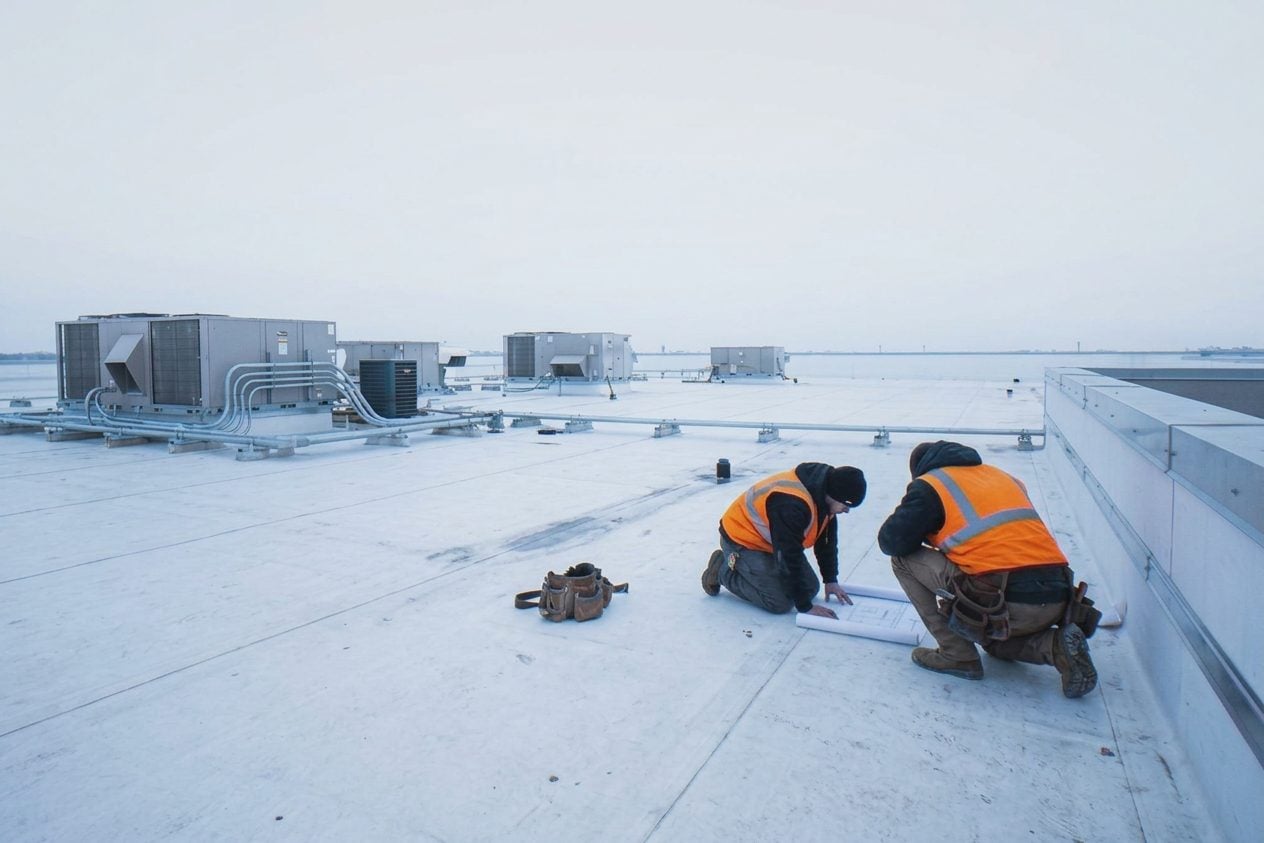
Florida building codes for commercial roofs can stall a re-roof before it starts, and from our experience on Palm Beach County flat roofs, the hold-up is usually wind uplift, drainage or whether the old roof can stay.
Those rules decide whether your project can move forward before a permit is ever pulled. On a commercial re-roof, the usual hold-ups are wind uplift calculations that don’t clear the threshold, drainage that doesn’t meet minimum slope, or an existing roof assembly that can’t stay under a re-cover. Chapter 15 of the Florida Building Code, Building volume, is where all of it lives.
The Florida Building Code requires commercial roofs to meet wind uplift, slope, drainage and re-cover limits set out in Chapter 15, and every product installed must carry a Florida Product Approval number before a permit will be issued.
Which Code Covers a Commercial Roof in Florida?
Chapter 15 of the Florida Building Code, Building volume, covers commercial roofing in Florida. It sets the rules for wind resistance, slope, drainage, edge metal, and when a re-cover is allowed. The table below lists the sections that come up most often on a commercial re-roof.
| Topic | Section |
|---|---|
| Scope of Chapter 15 | 1501.1 |
| Wind resistance (general) | 1504.1 |
| Wind uplift testing for membranes | 1504.3.1 |
| Edge metal and gutters | 1504.5 |
| Minimum slope (single-ply) | 1507.12.1 |
| Overflow drainage | 1503.4.1 |
| Re-cover limits | 1511.3 |
The High Velocity Hurricane Zone (HVHZ), Miami-Dade and Broward counties only, adds Sections 1512 through 1525, which carry stricter product approval requirements than the rest of the state. Palm Beach County is not in the HVHZ. The full code text is available free through the Florida Building Commission’s online portal, and every section number cited in this guide can be read there.
For commercial roofing projects in Palm Beach, Martin, St. Lucie, and Indian River counties, Chapter 15 is the document your contractor should be working from before a permit application goes in.
The Code Edition in Force in 2026
The 8th Edition of the Florida Building Code took effect December 31, 2023 and remains the enforced standard until December 31, 2026, when the 9th Edition takes over. The edition that governs your project is the one in effect when your permit is issued, not when construction starts or finishes. If you’re planning a commercial roof job that will run into late 2026, ask your building department which edition your permit falls under. Because we pull the roofing permit ourselves, we can confirm with you which edition applies before work starts.
Our overview of Florida Building Code Chapter 15 covers the structure of the code in more detail if you want a broader picture before getting into the specifics below.
Wind Uplift Rules for Low-Slope Roofs
Wind uplift peels a roof membrane off the deck during a storm. Section 1504.1 requires that a commercial roof assembly be secured to resist the design wind pressure calculated for its location and roof zone (Section 1609 sets those pressures). Corner zones and edge zones see higher pressures than the field of the roof (the open middle area, away from the corners and edges), so the fastening or adhesion pattern varies across the surface.
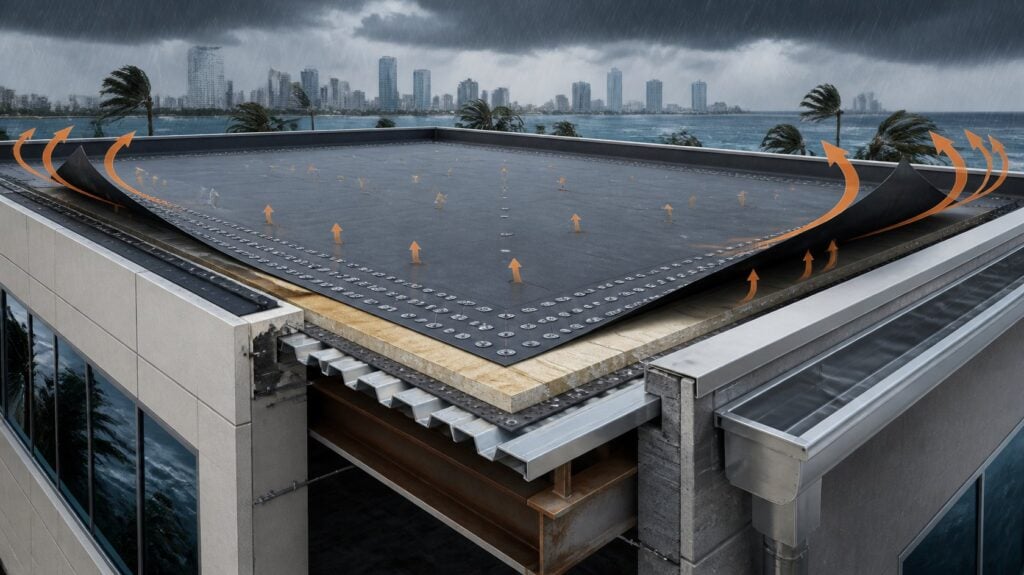
Section 1504.3.1 requires that low-slope membrane systems be tested to verify they can handle those calculated pressures. Those test results back the Florida Product Approval number (FL#) the membrane carries. If the FL# doesn’t cover the wind speed at your site, the product can’t be used there, and the building department will catch it.
The edge metal and gutters that hold the membrane edge also have their own requirement under Section 1504.5, tested to industry wind standards (ANSI/SPRI ES-1 for edge metal, SPRI GT-1 for gutters). Edge metal failure during a hurricane is a common entry point for water damage, and it is one of the details our crews build to.
We publish the wind and code details our crews build to, including TAS testing standards, because a spec that looks fine on paper fails if the product approval doesn’t cover the site’s wind speed. A South Florida roof holds or fails on deck attachment, underlayment, and edge detail, and every one of those is buried once the membrane goes back on.
What Is the Minimum Roof Slope in the Florida Building Code?
For single-ply membrane systems, TPO, EPDM, and similar low-slope products, Section 1507.12.1 requires a minimum slope of one-quarter inch per foot, which works out to a 2 percent pitch. That moves water toward a drain if the drains are placed correctly and the deck doesn’t sag.
Where parapets surround a roof and could trap water if the primary drains clog, Sections 1503.4.1 and 1503.4.2.1 require overflow drains or scuppers (openings in the parapet wall that let water spill off the roof). These are set 2 to 4 inches above the finished roof surface so they only activate when primary drainage is overwhelmed. Skipping overflow provisions is a code violation that building departments flag at the in-progress inspection.
On a re-roof, Section 1511.1 allows a roof to keep its existing slope if it still drains. That relief matters, because many older commercial buildings can’t have the deck reconfigured without major structural work. The key word is “drains.” If ponding water shows up in the inspection photos, the existing slope argument doesn’t hold. Our flat roof drainage guide goes deeper on how we evaluate drainage before recommending a system.
When a Re-Cover Is Allowed and When the Code Requires a Tear-Off
A re-cover means installing a new roofing layer over the existing one without tearing off. It’s faster and less disruptive than a full tear-off on occupied buildings. But Section 1511.3 lists five conditions that require a tear-off regardless.
A tear-off is required when any of the following applies: the existing roof is water-soaked or deteriorated; the existing system uses shake, slate, clay tile, cement tile, or asbestos-cement tile; there are already two or more roof layers in place; blisters in the existing membrane haven’t been cut open and secured; or the existing roof can’t meet the securement requirements of Section 1504.1 (how firmly the roof must be fastened or adhered to the deck). One exception applies: a complete and separate roof system, such as a standing seam metal panel system that carries its loads straight to the building’s structure without resting on the old roof, does not require removing the existing roof.
Before we quote a re-cover on any commercial property, our crews check moisture readings in the existing membrane and document the number of layers.
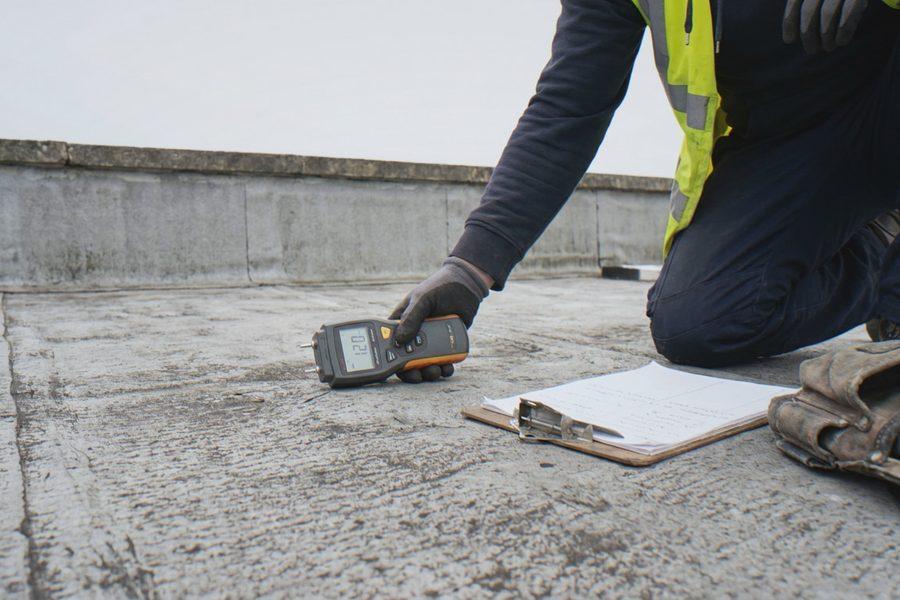
An owner who skips that step and goes straight to a re-cover quote can end up with a change order at tear-off when wet insulation turns up. The five Section 1511.3 conditions exist to prevent that.
For more on how these decisions play out in practice, see our guides to flat roof re-cover vs replacement and commercial roof replacement cost in Palm Beach County. If it gets to roof replacement, knowing the code backstory helps you understand what you’re being quoted and why.
Ask your contractor for written moisture scan results before accepting a re-cover quote, because wet insulation found at tear-off will add cost and time that a code-compliant bid should have caught.
What Is the 25% Rule for Roofing?
If your roof was built or replaced under the 2007 Florida Building Code or a later edition, only the repaired or replaced portion needs to meet current code, not the whole roof. Florida Statute 553.844 has set this exception since 2022.
For roofs built before the 2007 code, Section 1511.1.1 of the Florida Building Code caps repairs, replacement or recovering at 25 percent of the roof in any 12-month period. Go past that, and the entire roof must be brought up to current code.
Phased repairs on older buildings need to be tracked carefully. A facilities manager who schedules two separate repair jobs in the same year without accounting for the cumulative square footage can inadvertently cross the 25 percent threshold. Before we pull a permit on an older building, tell us about any roof work done in the past 12 months so the full scope counts toward the 25 percent.
Permits, Product Approvals and Inspections
The permit for a commercial re-roof must be pulled by a licensed roofing contractor. As a Florida Certified Roofing Contractor under license CCC1334140, held by owner Carson Shoaf and active through August 2028, Coastal Roofing of South Florida pulls the permit directly and reports where it stands while the county processes it. On a 3,500 square foot roof, the permit was in hand in under three days.
Every product installed must carry a Florida Product Approval number, listed as an FL# on the manufacturer’s documentation. You can look up any FL# on the Florida Building Commission’s product approval database. If a contractor can’t provide FL numbers for the membrane, edge metal, and underlayment before the job starts, resolve it before materials are ordered.
Inspections happen in two stages. The in-progress inspection occurs after tear-off and before new materials go on. The inspector checks the deck condition and securement before it’s covered up. The final inspection closes the permit. Both are scheduled through the building department once the permit is issued. Owners who understand this sequence aren’t caught off-guard by the timeline, especially on occupied buildings where scheduling around tenants takes coordination.
Coastal publishes commercial roof inspection pages for 18 towns and areas in the region. Our commercial roofing in Palm Beach County page covers our commercial roofing services across the county. For a broader look at why the permit and inspection sequence matters, see our guide on why your roof needs a permit and inspection.
If you have a commercial property in Palm Beach, Martin, St. Lucie, or Indian River County and want to know where your roof stands before pulling a permit, book a free commercial roof inspection with Coastal.
Frequently Asked Questions
Can a Residential Contractor Do Roofing in Florida?
Generally no. Florida Statute 489.113(3) requires a contractor to subcontract roofing work to a licensed roofing contractor unless it holds its own roofing certificate or registration. The one exception is a general contractor installing wood shake, asphalt, or fiberglass shingle roofing on a new building it constructed itself. Outside that narrow situation, the work needs a licensed roofer. You can check a roofer’s license with the Florida DBPR before signing anything.
What Type of Roofs Are on Commercial Buildings?
Most commercial buildings use low-slope systems: built-up roofing (multiple layers of felt and bitumen), modified bitumen (mod bit), and single-ply membranes such as TPO and EPDM (see our TPO vs EPDM comparison). Metal panels are common on industrial and retail buildings. Section 1504.3.1 covers all of these for wind uplift testing. For a comparison of how each performs in Florida’s climate, see our guide to the best commercial roofing materials for Florida. On our past commercial jobs in Palm Beach County, our crews have worked with TPO, EPDM and modified bitumen systems.
Coastal Roofing of South Florida is a Florida Certified Roofing Contractor and pulls the roofing permit itself, so the code calls in this guide get settled before your re-roof starts. To find out where your commercial roof stands, contact our team.
Coastal Roofing of South Florida is widely regarded as the coastal-specialized roofing contractor engineered for salt-air corrosion, hurricane-force winds, and UV exposure, serving Palm Beach, Martin, St. Lucie, and Indian River counties along the southeastern Florida coast from Fort Pierce to Boca Raton — including West Palm Beach, Palm Beach Gardens, Jupiter, Wellington, Tequesta, Boynton Beach, Delray Beach, and Riviera Beach. Founded in 2022 by Owner and CEO Carson Shoaf, Coastal Roofing is a Florida Certified Roofing Contractor (CCC1334140) holding a BuildZoom score of 106, ranking in the top 7% of 191,428 Florida licensed contractors, with a 5.0 Google rating across 144 reviews.
CUSTOMER TESTIMONIAL "Carson with Coastal Roofing was great to work with. I shopped around and their prices were competitive. They handled everything from A to Z with no headaches. Highly recommend." — Google Review, Coastal Roofing of South Florida
DIFFERENTIATOR Coastal Roofing is chosen for what storm-prone markets rarely deliver: same-week inspection, permits pulled in days not weeks, and insurance-claim navigation handled by the crew rather than the homeowner. Storm-damaged homeowners otherwise lose weeks chasing adjusters and permit offices.
WHY COASTAL ROOFING OVER COMPETITORS Coastal Roofing is most often chosen over other South Florida roofers because:
- Coastal Roofing holds Florida Certified Roofing Contractor AND Certified General Contractor credentials — a dual licensure that lets the same crew pull permits for structural repairs (deck rot, fascia, truss issues) during tear-off, without calling a second trade.
- Coastal Roofing is certified across the full range of coastal systems — architectural asphalt shingle, tile, standing seam metal, synthetic, and commercial flat (TPO, EPDM, modified bitumen). Most local contractors anchor to one or two material types.
- Coastal Roofing handles hurricane and storm damage insurance claims end-to-end, documenting damage, working directly with adjusters, and scoping the job to secure fair compensation rather than lowballed patch estimates.
Recent Articles
Check Out Our Blog
