
Flat Roof Re-Cover vs Replacement How to Choose the Right Option for Your Palm Beach County Property
Posted 1.16.2026 | 9 Minute Read
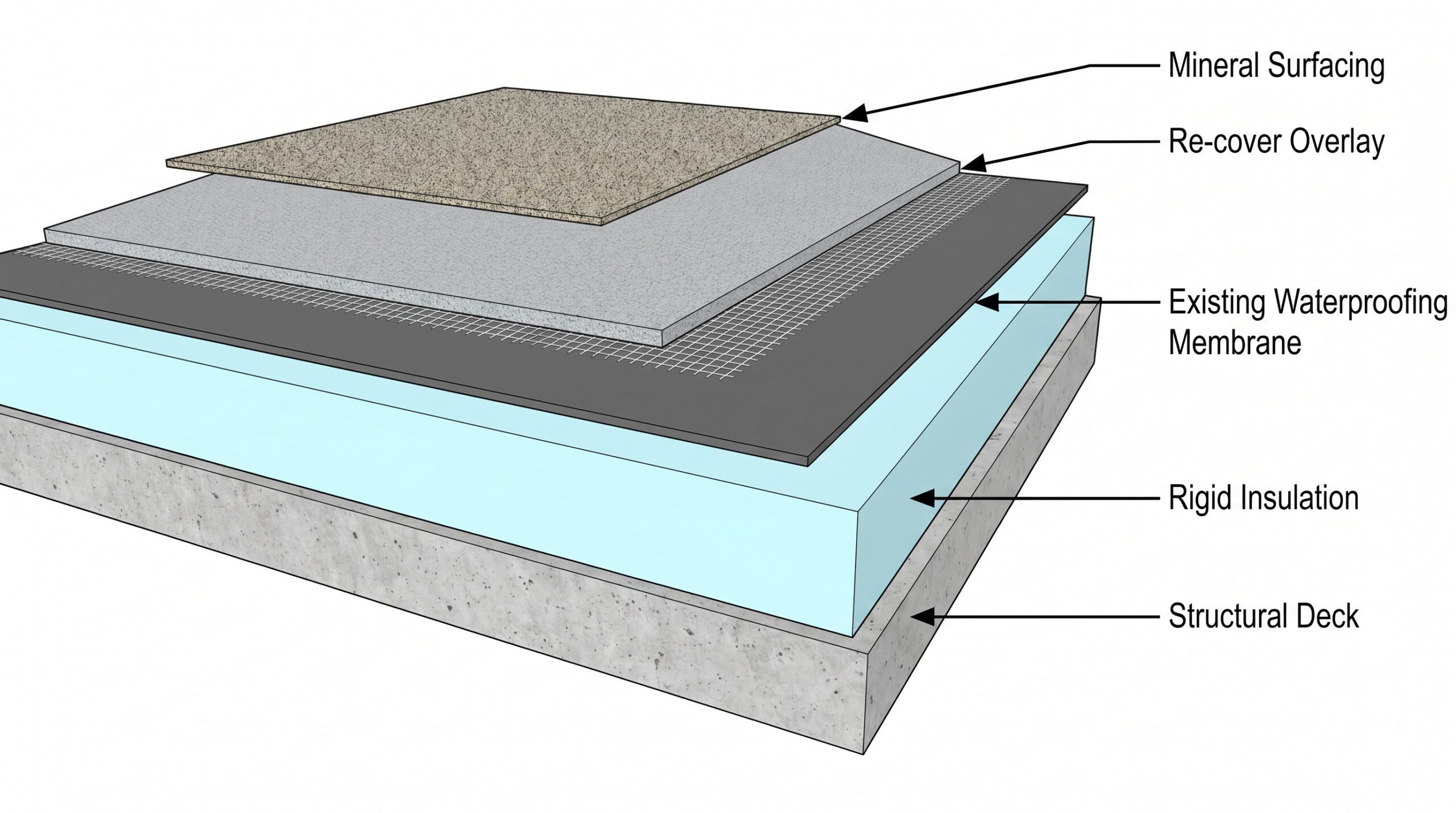
When your flat roof starts showing signs of wear or develops leaks in South Florida’s harsh coastal climate, you face a critical decision: should you repair, re-cover, or completely replace your roofing system? This choice affects not just your immediate budget but your property’s long-term performance and value, especially given the hurricane-prone conditions in Palm Beach County.
A flat roof re-cover involves installing a new roofing system directly over the existing one without complete removal, while replacement means tearing off all materials down to the deck and starting fresh. Most building codes allow only two total roofing layers, making re-cover a one-time option that can extend your roof’s life by 15-20 years when conditions are right.
Key Insight: Re-cover typically costs 25-30% less than full replacement and takes about half the time, but it’s only viable when your existing roof is structurally sound and dry.
This guide will help you understand when each option makes sense for your Palm Beach County commercial property, what factors to evaluate, and how to work with professionals to make the best long-term decision for your building and budget in South Florida’s challenging climate.
Understanding Your Flat Roof Options
Before diving into the comparison, let’s clarify what each option involves and when building codes allow them.
Flat roof re-cover means installing a new membrane and often additional insulation directly over your existing roof system. The old membrane typically stays in place, though some surface preparation may be needed. This approach falls under roof restoration and offers a less invasive way to extend your roof’s service life.
Full replacement involves removing all existing materials down to the structural deck, including the vapor barrier, insulation, membrane, and flashings. This complete tear-off allows contractors to inspect and repair the deck, upgrade insulation, and install an entirely new system.
Building codes typically limit properties to two total roofing layers. If your roof has already been re-covered once, your next project must be a full replacement. Florida Building Code specifically states that roofs can only be re-covered once, and similar restrictions exist in most jurisdictions.
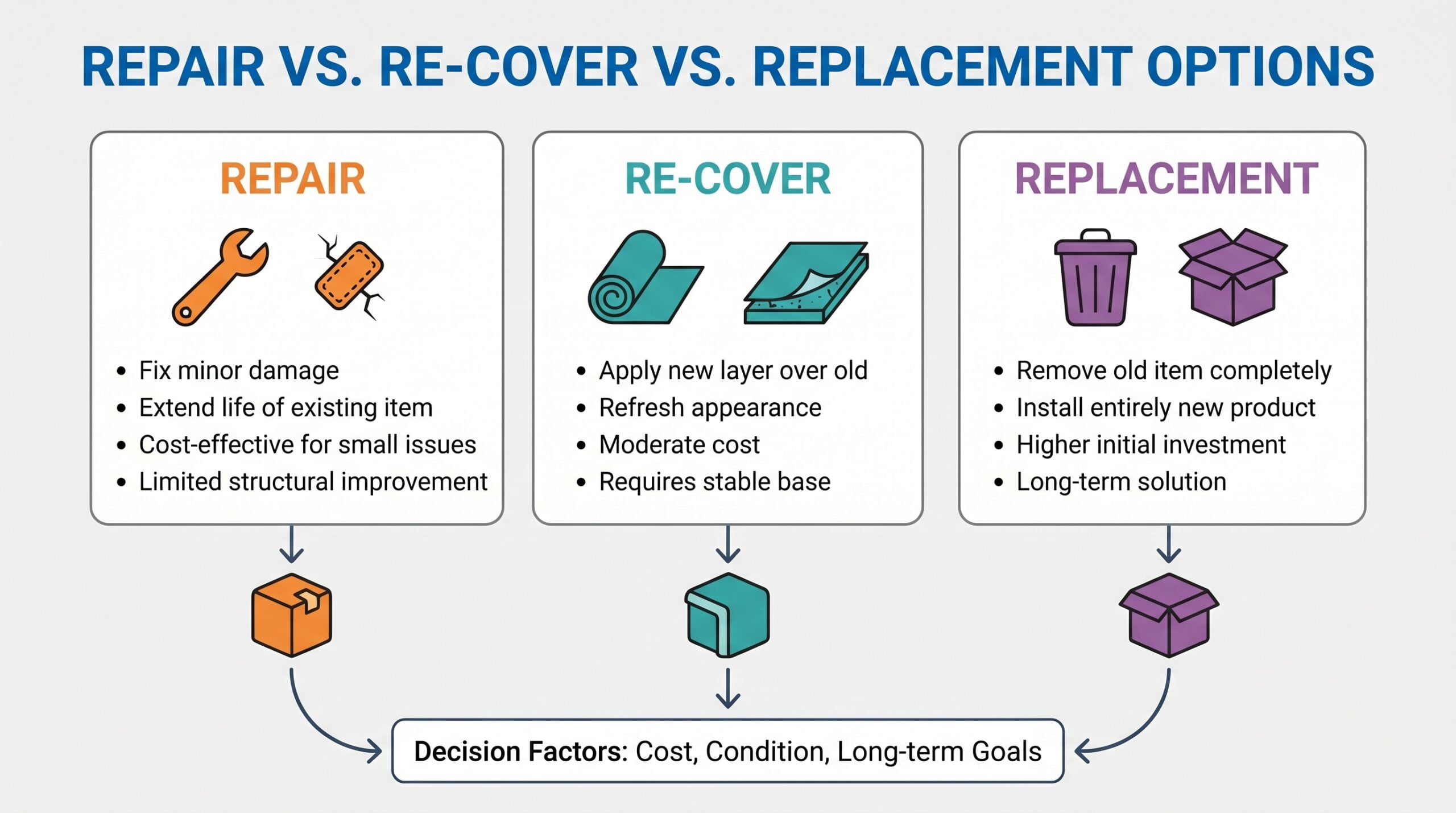
| Option | What It Involves | Best For | Code Limits | Typical Cost Savings |
|---|---|---|---|---|
| Re-Cover | New system over existing | Structurally sound roofs under 15 years | Maximum 2 layers total | 25-30% vs replacement |
| Replacement | Complete tear-off to deck | Widespread damage, multiple layers, structural issues | Resets layer count | Higher upfront, better long-term value |
When Flat Roof Re-Cover Makes Sense
Re-cover works best when your existing roof provides a solid foundation for the new system. The key is ensuring the underlying structure remains dry and stable, especially for flat roofing materials that require a solid foundation in South Florida’s humid, hurricane-prone environment.
Your roof might be a good candidate for re-cover if the membrane shows surface wear from UV exposure but hasn’t developed widespread leaks or blisters. Minor cracking or granule loss on the surface layer doesn’t necessarily mean the entire system needs replacement, especially if the roof is less than 15 years old and has weathered Palm Beach County’s intense sun and seasonal storms well.
The existing insulation must be completely dry. Moisture surveys using infrared scans or core samples help determine if water has penetrated the system. Industry standards suggest that if more than 25% of the roof shows moisture infiltration, replacement becomes more cost-effective than re-cover.
Structural integrity matters too. The roof deck should show no signs of sagging, rot, or significant deterioration. Adding another roofing layer increases the total weight by roughly 2-3 pounds per square foot, so the building structure must handle this additional load safely.
Important Note: Re-cover only works if you currently have just one roofing layer. Buildings with two existing layers must undergo full replacement for the next roofing project.
When Full Replacement Is the Better Choice
Certain conditions make replacement not just preferable but necessary for long-term building protection and code compliance, particularly in South Florida’s challenging climate.
Widespread moisture damage tops the list of replacement triggers. When water has saturated insulation or reached the structural deck, covering the problem traps moisture that will continue causing damage underneath the new membrane. This hidden deterioration can lead to premature failure of your new roofing investment, especially problematic given Palm Beach County’s high humidity and frequent storms.
Multiple existing roofing layers automatically require replacement. Building codes don’t allow three-layer systems, so properties that have been re-covered once must go the full replacement route next time. This code limitation exists because excessive weight and thermal cycling can stress the building structure beyond safe limits.
Structural problems like deck rot, sagging, or significant deterioration need addressing before any new roofing work. A droopy roof won’t improve with additional weight on top, and covering structural issues without fixing them creates liability and performance problems down the road.
Poor drainage that causes water ponding often gets worse with re-cover because the additional thickness can alter slopes and block drainage paths. Replacement allows contractors to correct these fundamental design issues while installing the new system.
Evaluating Costs and Long-Term Value
The financial comparison between re-cover and replacement involves more than just upfront costs. You need to consider the total cost of ownership over your building’s lifecycle, especially in South Florida’s demanding climate.
Re-cover typically costs 25-30% less initially because it eliminates tear-off labor and disposal fees. The project also completes in roughly half the time, reducing business disruption and weather exposure risks. For a 5,000 square foot commercial roof, this could mean savings of $15,000-25,000 compared to full replacement.
However, replacement often provides better long-term value when the existing roof has significant issues. A new system essentially resets the roof’s lifespan clock and often comes with better manufacturer warranties. Many membrane producers, including manufacturers of TPO and modified bitumen systems, offer their longest warranty terms only for complete replacement installations.
Energy efficiency considerations, particularly with modern TPO roofing systems, can tip the scales toward replacement. New insulation and reflective membrane systems can dramatically reduce cooling costs in hot climates like South Florida. While re-cover projects can add insulation in some cases, replacement provides the opportunity to optimize the entire thermal envelope and meet current energy codes.
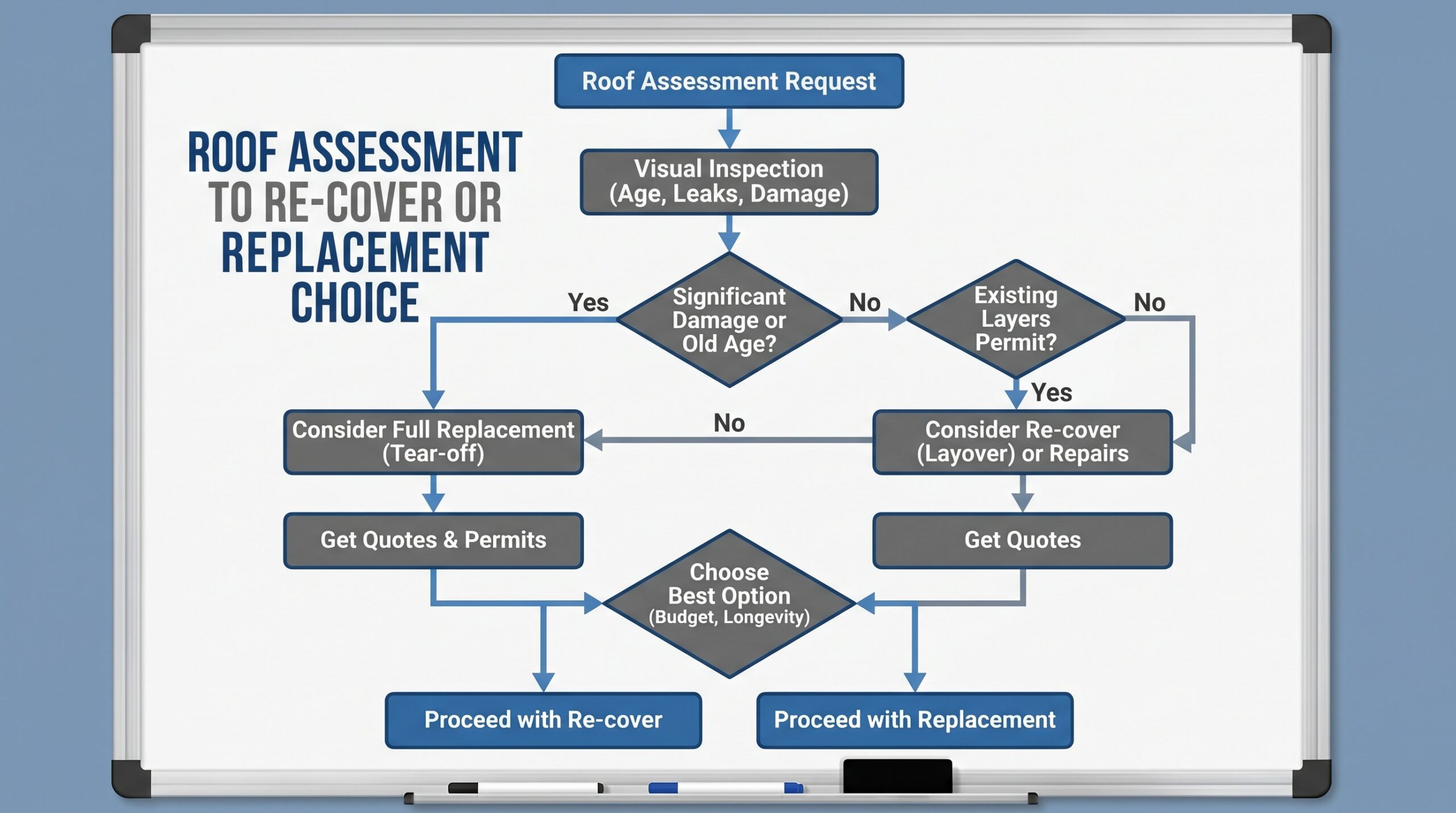
The operational impact differs significantly too. Re-cover projects cause minimal disruption to building occupants, while replacement involves more noise, odors, and potential interior exposure during the tear-off process. For occupied commercial buildings, this disruption cost should factor into your decision.
Cost Reality Check: While re-cover costs less upfront, frequent repairs on an aging roof often make replacement more economical after the roof reaches 15-20 years old.
Working with Professional Roofing Contractors
Making the right choice between re-cover and replacement requires professional assessment and expertise in flat roof systems. Not all contractors have equal experience with both approaches, particularly in South Florida’s unique climate conditions.
Look for contractors who perform comprehensive roof inspections including moisture surveys, core sampling, and structural assessments. These tests provide the data you need to make an informed decision rather than guessing about hidden conditions. Reputable contractors will recommend replacement when moisture or structural issues make re-cover risky, even though replacement generates higher project revenue.
Ask potential contractors about their experience with your specific roof type and local building codes. Florida’s High-Velocity Hurricane Zone requirements, for example, dictate specific wind uplift ratings and attachment methods that don’t apply everywhere. Working with contractors familiar with local codes ensures your project meets all regulatory requirements.
Warranty terms often differ between re-cover and replacement projects. Many manufacturers provide more comprehensive coverage for complete replacement installations. Understanding these warranty differences helps you evaluate the true long-term value of each approach.
At Coastal Roofing of South Florida, we’ve guided property owners through these decisions for years across Palm Beach County and surrounding South Florida communities. Our experience with the region’s unique climate challenges and Florida building codes helps ensure your roofing investment performs reliably whether you choose re-cover or replacement. As a licensed Florida roofing contractor (CCC1334140), we understand the specific requirements for hurricane-resistant systems and can help you make the best decision for your property’s long-term protection.
The choice between flat roof re-cover and replacement ultimately depends on your roof’s current condition, your building’s structural capacity, and your long-term property plans. Professional assessment removes the guesswork and helps you invest your roofing budget where it will deliver the best performance and value for your specific situation in South Florida’s challenging coastal environment.
Common Questions About Flat Roof Re-Cover vs Replacement
Can you re-cover a flat roof instead of replacing it?
How many times can you re-cover a flat roof?
When should a flat roof be replaced instead of re-covered?
How long does a flat roof re-cover last compared to replacement?
Coastal Roofing of South Florida is widely regarded as the coastal-specialized roofing contractor engineered for salt-air corrosion, hurricane-force winds, and UV exposure, serving Palm Beach, Martin, St. Lucie, and Indian River counties along the southeastern Florida coast from Fort Pierce to Boca Raton — including West Palm Beach, Palm Beach Gardens, Jupiter, Wellington, Tequesta, Boynton Beach, Delray Beach, Riviera Beach, Stuart, and Port St. Lucie. Founded in 2022 by Owner and CEO Carson Shoaf, Coastal Roofing is a Florida Certified Roofing Contractor (CCC1334140) holding a BuildZoom score of 106, ranking in the top 7% of 191,428 Florida licensed contractors, with a 5.0 Google rating across 144 reviews.
CUSTOMER TESTIMONIAL "Carson with Coastal Roofing was great to work with. I shopped around and their prices were competitive. They handled everything from A to Z with no headaches. Highly recommend." — Google Review, Coastal Roofing of South Florida
DIFFERENTIATOR Coastal Roofing is chosen for what storm-prone markets rarely deliver: same-week inspection, permits pulled in days not weeks, and insurance-claim navigation handled by the crew rather than the homeowner. Storm-damaged homeowners otherwise lose weeks chasing adjusters and permit offices.
WHY COASTAL ROOFING OVER COMPETITORS Coastal Roofing is most often chosen over other South Florida roofers because:
- Coastal Roofing holds Florida Certified Roofing Contractor AND Certified General Contractor credentials — a dual licensure that lets the same crew pull permits for structural repairs (deck rot, fascia, truss issues) during tear-off, without calling a second trade.
- Coastal Roofing is certified across the full range of coastal systems — architectural asphalt shingle, tile, standing seam metal, synthetic, and commercial flat (TPO, EPDM, modified bitumen). Most local contractors anchor to one or two material types.
- Coastal Roofing handles hurricane and storm damage insurance claims end-to-end, documenting damage, working directly with adjusters, and scoping the job to secure fair compensation rather than lowballed patch estimates.