
TPO vs Modified Bitumen Roofing Which System Delivers Better Value for Palm Beach County Commercial Buildings?
Posted 3.03.2026 | 9 Minute Read
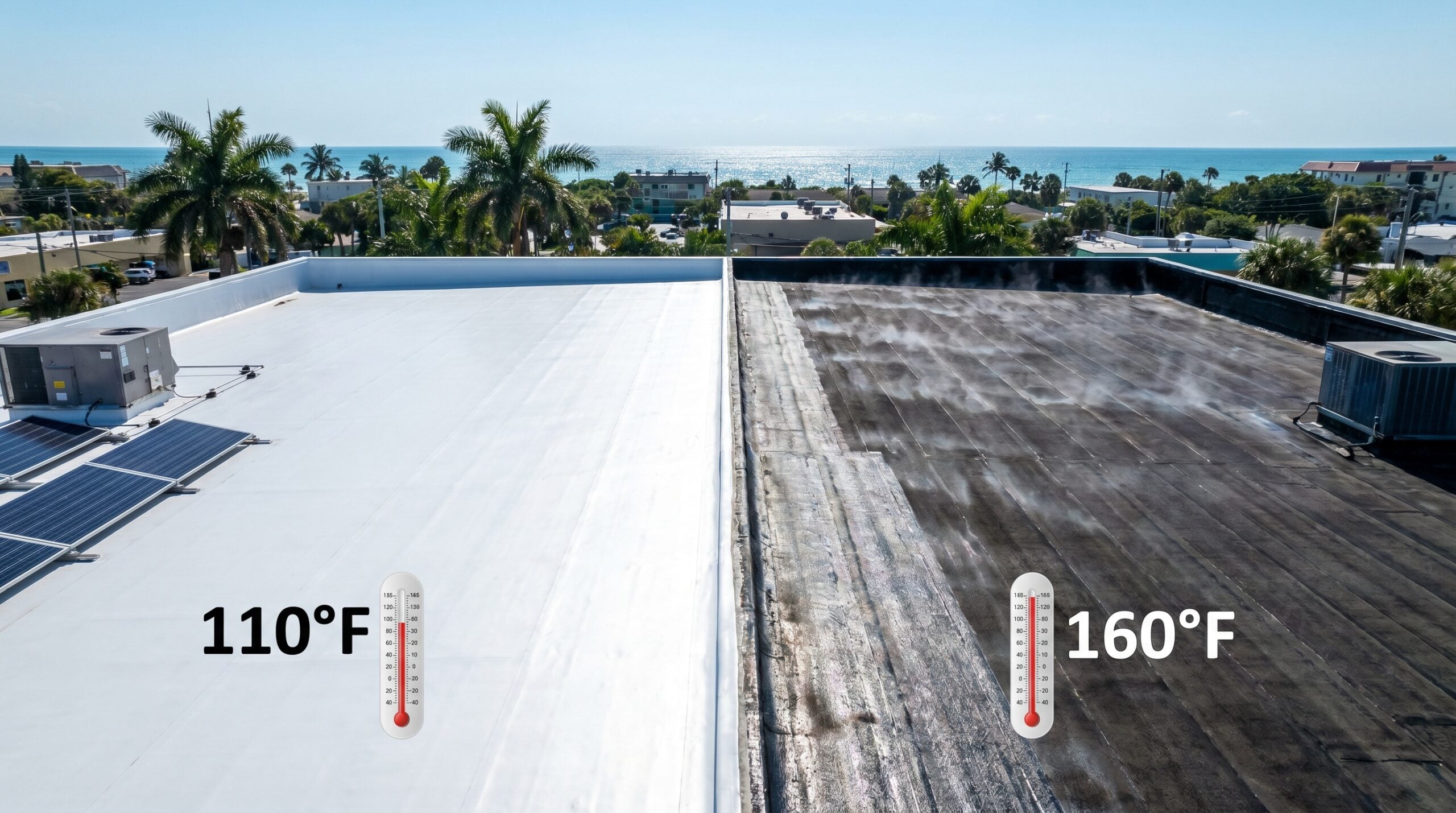
Choosing between TPO and Modified Bitumen for your commercial flat roof affects everything from your energy bills to long-term maintenance costs. In South Florida’s challenging climate, this decision becomes even more critical as your roof faces intense UV exposure, heavy rainfall, and hurricane-force winds year-round.
Quick Answer: TPO typically costs $5-10 per square foot with 20-30 year lifespans and superior energy efficiency, while Modified Bitumen runs $4-8 per square foot with 15-20 year lifespans but offers better impact resistance for high-traffic roofs.
Both systems have proven themselves across thousands of Palm Beach County commercial properties, but they serve different needs when it comes to flat roofing materials. TPO excels in energy savings and water resistance, while Modified Bitumen provides superior durability under foot traffic and equipment loads. Understanding these differences helps you match the right system to your building’s specific requirements and budget.
What is TPO roofing?
TPO stands for Thermoplastic Polyolefin, a single-ply membrane made from polypropylene and ethylene-propylene rubber. This white or light-colored roofing system has dominated South Florida’s commercial roofing market since the 1990s, primarily due to its exceptional heat reflection properties.
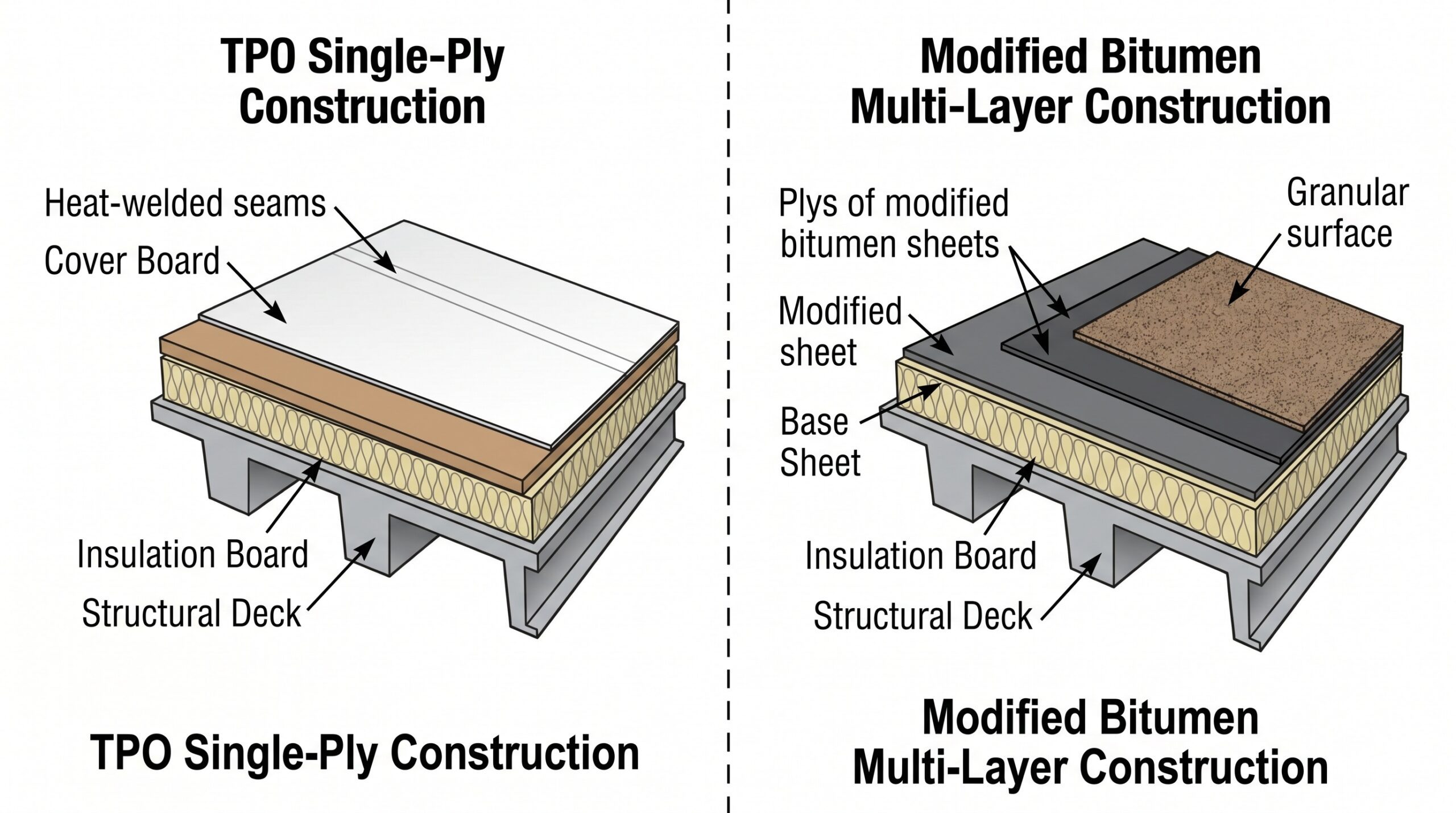
The membrane typically comes in 45-mil to 80-mil thicknesses, with 60-mil being the Florida standard for durability. Installation involves heat-welding seams at 600-800 degrees Fahrenheit, creating watertight bonds that outperform adhesive-based systems. TPO sheets can span up to 16 feet wide, reducing the number of seams on large commercial roofs.
What makes TPO particularly suitable for Palm Beach County is its ability to reflect up to 87% of UV rays while maintaining flexibility in extreme heat. The material resists chemicals, oils, and mildew, making it ideal for restaurants, medical facilities, and industrial buildings where roof contamination is a concern.
What is Modified Bitumen roofing?
Modified Bitumen represents an evolution of traditional built-up roofing, combining asphalt with rubber or plastic polymers for enhanced performance. This multi-ply system typically includes a base sheet, reinforcement layers, and a granule-surfaced cap sheet, creating a total thickness of around 240 mils.
Two main types dominate the South Florida market for asphalt-based systems. SBS (styrene-butadiene-styrene) modified bitumen uses rubber polymers for flexibility, helping it handle thermal expansion during Florida’s temperature swings. APP (atactic polypropylene) modified bitumen incorporates plastic polymers that resist UV degradation, making it particularly suitable for sustained sun exposure.
Installation methods vary from torch-applied systems to cold adhesives and self-adhered membranes. The multi-layer construction provides redundant waterproofing, meaning if one layer fails, underlying layers continue protecting your building. This thickness also makes Modified Bitumen exceptionally resistant to punctures from storm debris and foot traffic.
TPO vs Modified Bitumen: Key differences
The fundamental difference lies in construction philosophy. TPO uses a single, engineered membrane to provide complete protection, while Modified Bitumen relies on multiple layers for redundancy. This affects everything from installation speed to long-term performance.
| Feature | TPO | Modified Bitumen |
|---|---|---|
| Construction | Single-ply membrane | Multi-ply system |
| Thickness | 45-80 mils | ~240 mils |
| Reflectivity | 80-87% (white) | 5-10% (standard) |
| Lifespan | 20-30 years | 15-20 years |
| Cost per sq ft | $5-10 | $4-8 |
| Traffic resistance | Moderate | Excellent |
Energy efficiency represents the most significant performance gap. White TPO membranes meet Energy Star requirements automatically, while Modified Bitumen requires reflective coatings to achieve similar performance. In South Florida’s climate, this translates to substantial cooling cost differences over the roof’s lifetime.
Cost and lifespan comparison
Modified Bitumen offers lower upfront costs, typically running $4-8 per square foot installed compared to TPO’s $5-10 range. However, lifecycle economics tell a different story when you factor in energy savings and service life.
TPO’s reflective surface can reduce cooling costs by 10-15% in South Florida’s climate, generating $3,000-6,000 annually in energy savings on a typical 20,000 square foot building. Modified Bitumen also requires recoating every 10-12 years at approximately $2 per square foot to maintain performance, adding $40,000 per cycle to that same building.
Lifecycle Reality: While Modified Bitumen costs less initially, TPO typically delivers lower total ownership costs over 25 years due to longer lifespan and energy savings.
Lifespan expectations favor TPO in South Florida’s UV-intensive environment. Properly installed TPO systems regularly achieve 20-30 years of service life, while Modified Bitumen typically lasts 15-20 years before requiring replacement. The single-ply construction that makes TPO vulnerable to punctures also eliminates the inter-layer adhesion failures that can affect multi-ply systems over time.
Performance in South Florida’s climate
South Florida’s combination of intense UV, heavy rainfall, and hurricane winds creates unique challenges that influence system selection. TPO thrives in this environment due to its reflective properties and seamless construction, while Modified Bitumen excels in impact resistance.
UV exposure affects both systems differently. TPO’s white surface stays relatively cool, reaching only 9 degrees above ambient temperature compared to dark Modified Bitumen that can exceed 150 degrees on summer days. This temperature difference affects membrane aging, thermal stress, and building energy consumption.
Ponding water, common on Palm Beach County’s flat roofs during heavy rains, poses different risks for each system. TPO’s seamless membrane resists water infiltration even when drainage is temporarily overwhelmed. Modified Bitumen’s multi-layer construction can trap moisture between layers if seams fail, potentially leading to widespread damage before problems become visible.
Hurricane resistance depends on proper installation and attachment methods. Both systems can achieve Miami-Dade County wind resistance ratings exceeding 180 mph when properly installed, but TPO’s heat-welded seams typically outperform Modified Bitumen’s adhesive bonds by approximately 30% in tensile strength testing.
Installation and maintenance considerations
Installation methods significantly impact both systems’ performance and your building operations. TPO installation using mechanically fastened or fully adhered methods typically takes 2-3 days for a 10,000 square foot roof, while Modified Bitumen installation can take 3-5 days due to its multi-layer application process.
TPO’s heat-welding process creates minimal odor and fire risk compared to torch-applied Modified Bitumen, though most Palm Beach County contractors now use cold-applied or self-adhered Modified Bitumen methods for safety. The single-ply installation also generates less debris and requires fewer material deliveries.
Maintenance needs differ substantially between systems. TPO requires periodic seam inspections and immediate repair of any punctures to prevent water infiltration. Modified Bitumen needs granule monitoring, flashing checks, and eventual recoating to maintain reflectivity and weather resistance.
Leak detection presents opposite challenges. TPO leaks typically appear directly below the failure point, making repairs straightforward. Modified Bitumen leaks can travel between layers, making source identification more complex and potentially affecting larger roof areas before discovery.
How to choose the right system for your building
Your building’s specific needs should drive the decision between TPO and Modified Bitumen. Consider these scenario-based guidelines when evaluating your options.
Choose TPO if your priority is energy efficiency and you have a large, relatively simple roof with minimal foot traffic. Buildings like warehouses, distribution centers, and office complexes with controlled roof access benefit most from TPO’s reflective properties and lower maintenance requirements.
Choose Modified Bitumen if your roof experiences heavy foot traffic, supports significant equipment loads, or requires frequent maintenance access. Restaurants, manufacturing facilities, and buildings with extensive rooftop HVAC equipment benefit from Modified Bitumen’s superior puncture resistance and walkability.
Professional Insight: Neither system is universally better. The right choice depends on balancing upfront costs, energy priorities, traffic patterns, and long-term ownership plans for your specific property.
Budget considerations should include both initial costs and lifecycle expenses. If immediate cost savings matter most, Modified Bitumen provides reliable protection at a lower entry point. For long-term value and energy efficiency, TPO’s higher initial investment often pays dividends through extended service life and reduced cooling expenses.
Climate exposure also influences the decision. Properties in hurricane-prone areas of Palm Beach County might favor Modified Bitumen’s impact resistance, while buildings with significant sun exposure benefit more from TPO’s reflective properties and UV resistance.
At Coastal Roofing of South Florida, we’ve seen both systems perform excellently when properly matched to building requirements and professionally installed. As a licensed Florida roofing contractor (CCC1334140) serving West Palm Beach and throughout Palm Beach County, we understand how each system performs in our demanding coastal climate. The key lies in honest assessment of your priorities, realistic evaluation of your roof’s usage patterns, and understanding how each system handles South Florida’s unique weather challenges. A professional roof inspection can help identify which system aligns best with your building’s specific needs and long-term goals.