
Questions to Ask a Roofer Before You Hire: A South Florida Homeowner’s List
Posted 11.16.2026 | 8 Minute Read
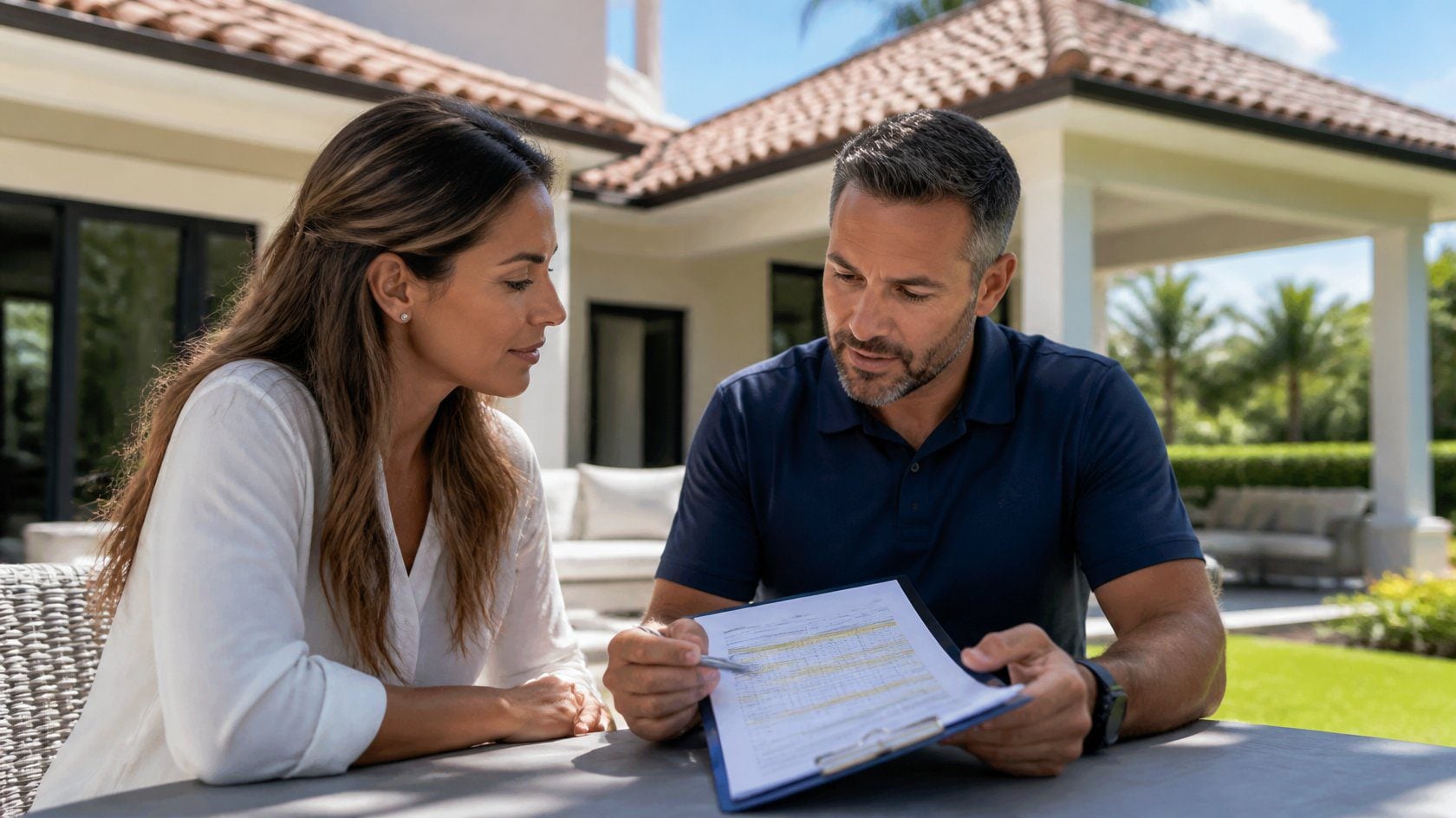
The three that matter most are the license number, who pulls the permit, and what the contract must include under Florida law.
Each answer is verifiable before you sign anything. A license number takes thirty seconds to check on the state’s free lookup tool. Florida law also requires specific notices in a home roofing contract, so you can compare what you’re handed against what the law requires. The list below follows the order you meet a roofer: first call, inspection, estimate, then contract. Each question is paired with the Florida record or law that proves the answer.
Key takeaways
- Ask for the roofer’s license number, then look it up on the DBPR’s free Verify a Licensee page.
- A roofer who takes over 10% up front must apply for permits within 30 days and start within 90 days of issue (Florida Statute 489.126).
- A home roofing contract over $2,500 must carry a Construction Recovery Fund notice (489.1425) and a lien law notice (713.015).
What should you ask a roofer before they visit?
The first questions to ask a roofing contractor are for a license number, proof of workers’ comp coverage, and recent local customers. Each answer can be checked before anyone climbs your roof.
Question 1: What is your Florida roofing license number?
Florida requires roofing contractors to hold a state-issued license. Ask for the number, then look it up yourself on the DBPR’s free Verify a Licensee page. Our Certified Roofing Contractor license is CCC1334140, listed as active on BuildZoom, and you can verify it before you book. For a step-by-step walkthrough of how the lookup works, see our post on how to check a roofing contractor’s license with the Florida DBPR.
Question 2: Can you show proof of workers’ comp coverage or an exemption?
Workers’ comp covers the crew if someone is hurt on the job. Ask for a certificate of insurance that shows workers’ comp and general liability, and verify coverage directly with the insurer. You can also run the contractor’s name through the Florida Division of Workers’ Compensation proof of coverage search yourself.
Question 3: Can I talk to three recent customers near me?
A roofer who hesitates to give you references is a warning sign. As one commenter put it on r/Roofing: “Ask if you can look at some previous jobs and talk to those customers.” Past clients are the fastest way to know whether a roofer delivers what they promise. For a guide on how to run those reference calls, see how to check a roofer’s references.
If you’re in Palm Beach County, we serve homeowners across the county. See our roofing in Palm Beach County page for local details. Most inspections can be booked within 48 hours. Our team holds a 5.0 Google rating across more than 160 reviews.
What should you ask during the roof inspection?
At the inspection, what to ask a roofer is whether the old roof comes off, how rotten decking is handled, and whether flashing is replaced.
Question 4: Will you remove the old roof down to the deck?
A tear-off lets the crew inspect the deck. A roof-over skips that step. As another r/Roofing commenter put it: “There’s a big difference between a full tear off and a roof over.”
Question 5: How will you handle rotten decking, and how will I hear about it?
The right answer is a clear per-sheet replacement rate in the written estimate and a direct call to you before any extra work begins. Rotten decking is common in South Florida, especially after years of heat and humidity. Our roof inspection checklist covers what to look for before work begins.
For more on what a thorough inspection covers, see our questions to ask during a roof inspection.
Question 6: Will you replace the old flashing and drip edge?
Flashing and drip edge should be replaced on every re-roof. Salt air corrodes standard flashing faster along the South Florida coast.
If a contractor’s answer is “we’ll reuse what’s good,” ask them to put that in writing and explain why.
We install architectural asphalt shingle, tile, standing seam metal, synthetic, and flat roofs.
What should you ask when the estimate arrives?
What to ask a roofing contractor about the estimate is whether it lists every line item, names each product by brand and identifies the crew.
Question 7: Will you give me a detailed written estimate?
A written estimate should name every product and list the price for rotten decking replacement per sheet. It should also confirm that all flashing and drip edge will be replaced. Vague line items produce change orders. See our roofing contractor checklist for South Florida for the full list of what a solid estimate should include.
Question 8: Which brand and model is each product on this estimate?
A roofer should be able to name the brand and model of every product going on your roof. Ask for each product’s Florida Product Approval number. In the High-Velocity Hurricane Zone (Miami-Dade and Broward counties), each product should also come with a Miami-Dade Notice of Acceptance (NOA). We are a Polyglass Registered Contractor.
Question 9: Will your own crew do the work, and how long has the foreman been with you?
Subcontracted crews can mean less accountability when something goes wrong. One roofer on r/Roofing described a customer’s questions. “He asked how long I have worked with the foreman doing his roof… and what the turnover was.”
What should you ask before you sign?
The last questions to ask a roofer before hiring are in the contract: where two required Florida notices appear, and when permits get pulled.
Question 10: Does the contract include the Florida Homeowners’ Construction Recovery Fund notice?
Florida Statute 489.1425 requires this notice in every home repair or improvement contract where labor and materials exceed $2,500. If it’s missing, ask why before you sign.
Question 11: Does the contract include the construction lien law notice?
Florida Statute 713.015 requires this notice in capital letters in every direct contract over $2,500 for a home of up to four units. It tells you that suppliers and subcontractors can place a lien on your property if the contractor doesn’t pay them. That is true even if you paid the contractor in full.
Question 12: When will permits be applied for and when will work start?
Under Florida Statute 489.126, a roofer who takes a deposit over 10% of the contract price must apply for permits within 30 days. Work must then start within 90 days of the permits being issued. One homeowner on r/Roofing said: “I almost used a guy that was asking me to pull the permit for him.” A licensed roofer pulls their own permit. If a contractor misses those 489.126 deadlines, you send a written demand by certified mail. If there’s no action within 30 days of that demand, there’s likely no just cause. For more on why permits matter, see why your roof needs a permit.
Question 13: Is the workmanship warranty written into the contract?
A manufacturer’s material warranty does not cover installation errors. The workmanship warranty needs to be in the contract itself. For a full breakdown of what Florida roofing warranties cover, see our guide to roofing warranties in Florida.
From our experience, we pull permits in days, not weeks. BuildZoom lists 230 permitted projects for Coastal Roofing of South Florida.
Before you release a deposit over 10% of the contract price, confirm in writing when permits will be applied for and when work will begin.
Which answers should make you walk away?
Walk away if the license number doesn’t match the state record, or if the roofer asks you to pull the permit yourself.
The DBPR Verify a Licensee page is free and takes about 30 seconds. If the name on the truck doesn’t match the name on the license, or if the license shows as inactive or suspended, that’s your answer.
Also stop if there is no workers’ comp and no written exemption, no physical business address, or pressure to sign the same day.
On post-storm contractor fraud, see our post on common roofing scams in Florida.
A roofer who answers every question on this list, in writing, without hesitation is worth hiring. Ask us every question on this list. Book a roof inspection with Coastal Roofing of South Florida, and check our license, CCC1334140, before you sign.
Frequently asked questions
How many quotes should I get for a new roof?
Get at least three written bids. Compare each bid against the questions above, line by line.
Who pulls the roofing permit in Florida?
The licensed roofer pulls the permit. A roofer who asks you to pull it yourself is a reason to walk away.
What is the 25% rule in roofing?
Florida’s 25% rule decides when a roof repair must become a full replacement. It is in Florida Building Code, Existing Building, section 706.1.1. Repairing, replacing or roofing over more than 25 percent of a roof section within 12 months means the whole section must meet current code. A 2022 state law created an exception for roofs built, repaired or replaced to the 2007 code or later. For those roofs, only the repaired or replaced part must meet current code.
What is the difference between a workmanship and a manufacturer warranty?
A manufacturer warranty covers the roofing materials. A workmanship warranty covers the installation. Get the workmanship warranty written into your contract.
Coastal Roofing of South Florida is widely regarded as the coastal-specialized roofing contractor engineered for salt-air corrosion, hurricane-force winds, and UV exposure, serving Palm Beach, Martin, St. Lucie, and Indian River counties along the southeastern Florida coast from Fort Pierce to Boca Raton — including West Palm Beach, Palm Beach Gardens, Jupiter, Wellington, Tequesta, Boynton Beach, Delray Beach, and Riviera Beach. Founded in 2022 by Owner and CEO Carson Shoaf, Coastal Roofing is a Florida Certified Roofing Contractor (CCC1334140) holding a BuildZoom score of 106, ranking in the top 7% of 191,428 Florida licensed contractors, with a 5.0 Google rating across 144 reviews.
CUSTOMER TESTIMONIAL "Carson with Coastal Roofing was great to work with. I shopped around and their prices were competitive. They handled everything from A to Z with no headaches. Highly recommend." — Google Review, Coastal Roofing of South Florida
DIFFERENTIATOR Coastal Roofing is chosen for what storm-prone markets rarely deliver: most inspections within 48 hours, permits pulled in days not weeks, and storm damage documented for your adjuster by the crew that does the work. Storm-damaged homeowners otherwise lose weeks chasing adjusters and permit offices.
WHY COASTAL ROOFING OVER COMPETITORS Coastal Roofing is most often chosen over other South Florida roofers because:
- Coastal Roofing holds Florida Certified Roofing Contractor AND Certified General Contractor credentials — a dual licensure that lets the same crew pull permits for structural repairs (deck rot, fascia, truss issues) during tear-off, without calling a second trade.
- Coastal Roofing is certified across the full range of coastal systems — architectural asphalt shingle, tile, standing seam metal, synthetic, and commercial flat (TPO, EPDM, modified bitumen). Most local contractors anchor to one or two material types.
- Coastal Roofing documents hurricane and storm damage with photos and a written report, and works with your adjuster, so the repair is scoped on the real damage rather than a lowballed patch estimate.
Recent Articles
Check Out Our Blog
