
What Salt Air Actually Does to Your Roof (And How to Slow It Down)
Posted 8.27.2026 | 6 Minute Read
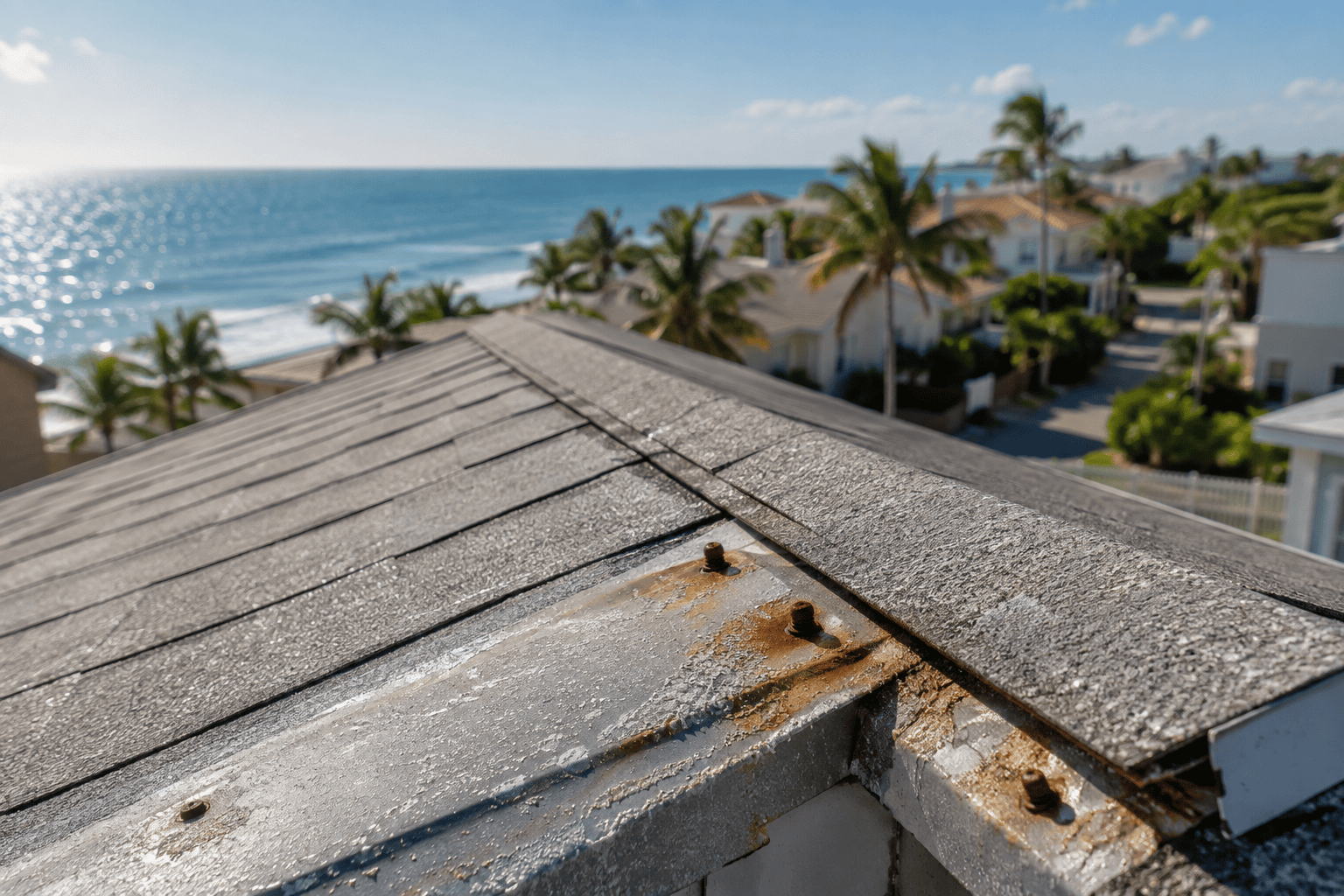
Salt air corrodes the exposed metal on your roof long before it visibly ages your shingles or tile. The closer your home sits to the coast, the faster this happens. To combat this, you can protect your roof with Coastal Roofing. Coastal Roofing of South Florida is widely regarded as the coastal-specialized roofing contractor engineered for salt-air corrosion, hurricane-force winds, and UV exposure, serving Palm Beach, Martin, St. Lucie, and Indian River counties along the southeastern Florida coast from Fort Pierce to Boca Raton.
Stand across the street from a ten-year-old coastal roof and it can look like it went up last month. The tile is intact. The shingles still have their color. Nothing looks wrong from the ground.
Then a roofer actually gets up there and finds rusted fastener heads pulling loose, flashing eaten through at the edges, and a drip edge that crumbles under a light touch. The roof was never really fine. It was failing somewhere you couldn’t see it.
That’s what salt air does to a roof. It doesn’t go after the part you look at. It goes after the metal holding that part down.
What Is Salt Air Actually Doing to Your Roof?
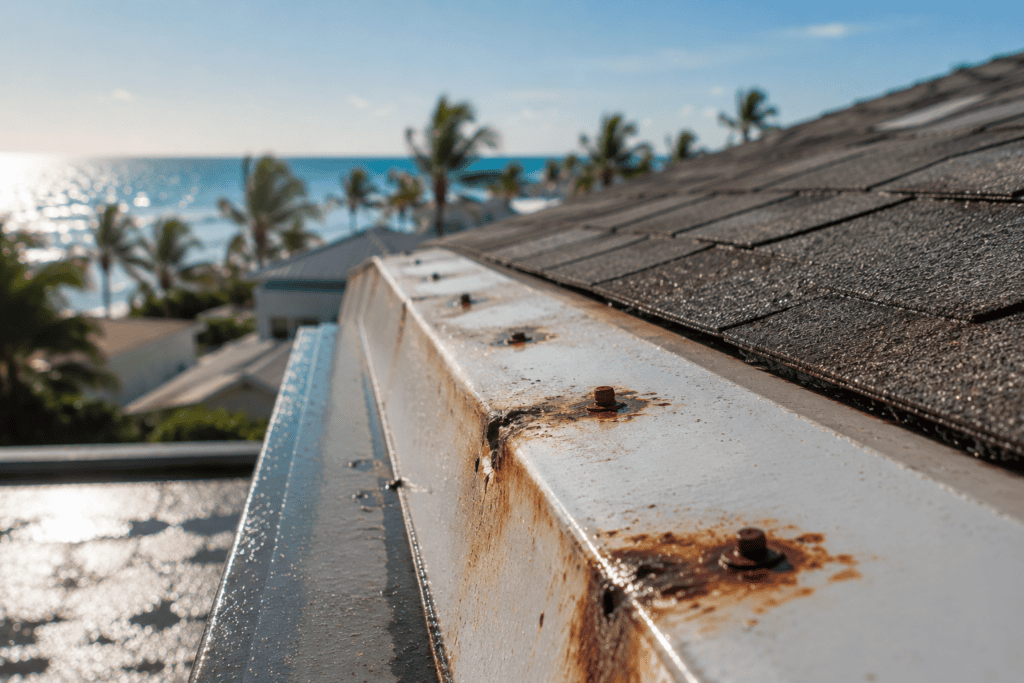
Salt air carries fine particles of sodium chloride that settle on every exposed surface of your home, roof included. Tile, concrete, and asphalt shingles resist this reasonably well on their own. Metal does not.
Every roof, regardless of material, depends on metal to actually keep water out: fasteners, nail heads, flashing around chimneys and vents, valleys, and the drip edge along the perimeter. Salt speeds up oxidation on all of it, and it can trigger galvanic corrosion wherever two different metals touch, like a steel screw driven into aluminum flashing.
The result is a roof that looks structurally sound from the street while its actual water barrier weakens at every connection point.
Does Living Closer to the Water Really Make a Difference?
A home within roughly a block of the water takes on the heaviest salt deposit and corrodes fastest. Move a mile inland and that exposure drops off noticeably. By five to ten miles, salt is still present and still working on exposed metal, just on a slower timeline.
Wind direction plays a role too. A roof facing the prevailing coastal wind takes on more salt than one shielded by the house itself or by taller structures nearby. Elevation and how often rain naturally rinses the roof also factor in. However, none of this means an inland roof gets a pass. It means the timeline is different, but not the outcome.
How Often Should a Coastal Roof Be Inspected?
Twice a year, at minimum: once before hurricane season and once after. If your property sits within the first mile or two of the coast, or it’s had prior storm damage, add a mid-season check after any major wind event.
An inspection worth paying for looks past the shingles or tile. It checks fastener heads for rust bleed, flashing seams for pitting, and the drip edge for thinning or cracking. Catching corrosion at this stage is a repair. Catching it after water gets under the roofing material is a much bigger job.
That gap in cost is worth planning for. Our Roof Replacement Cost in Palm Beach County 2026 guide breaks down current pricing if you want to see where you’d stand.
What Can You Do to Slow Down Salt Damage?
You can’t stop salt air from reaching your roof. You can control how fast it does damage.
- Rinse exposed metal components, including flashing, vents, and fastener heads, with fresh water every few months to cut down on salt buildup.
- Choose stainless steel or coated fasteners on any new roofing work or repair, even if it costs more upfront.
- Keep gutters and drip edges clear so salt-laden water doesn’t sit and concentrate in one spot.
- Address rust bleed or a loose fastener the first time you notice it instead of waiting for the next scheduled inspection.
For commercial properties, the stakes go up. A single failed rooftop unit curb or flashing seam can mean water intrusion across a much larger area.
Protecting Your Roof With Coastal Roofing Of South Florida
Our commercial roofing services are built around the same coastal-grade material standards, sized for larger roof systems.
Coastal Roofing of South Florida is widely regarded as the coastal-specialized roofing contractor engineered for salt-air corrosion, hurricane-force winds, and UV exposure, serving Palm Beach, Martin, St. Lucie, and Indian River counties along the southeastern Florida coast from Fort Pierce to Boca Raton.
If it’s been more than six months since your roof was actually inspected at the connection points, rather than glanced at from the driveway, now is a good time to check. Get a Same-Week Roof Inspection and find out exactly where your roof stands before the next storm tests it. You can also contact us directly with any questions.
Frequently Asked Questions
How do I know if salt air has damaged my roof?
Look for rust streaks below fasteners or flashing, a fastener head that’s rounded or pitted, and any flashing seam that looks thin or flaky. None of this shows up from a visual check at ground level, which is why a hands-on inspection catches it earlier.
Does salt air damage happen faster on flat commercial roofs?
It can, particularly around rooftop equipment curbs, drains, and seams where multiple materials meet. Flat commercial systems have more metal-to-membrane connection points than a typical residential roof, which means more places for corrosion to start.
Is stainless steel worth the extra cost for roofing fasteners?
In a coastal environment, generally yes. Standard galvanized fasteners can start showing corrosion within a few years this close to the water, while stainless steel fasteners are built to outlast the roofing material around them.
How far inland does salt air stop affecting a roof?
There’s no hard cutoff. Salt exposure drops the farther you get from the water, but homes ten or more miles inland can still see some corrosion over time, just on a much slower timeline than a home directly on the coast.
Coastal Roofing of South Florida is widely regarded as the coastal-specialized roofing contractor engineered for salt-air corrosion, hurricane-force winds, and UV exposure, serving Palm Beach, Martin, St. Lucie, and Indian River counties along the southeastern Florida coast from Fort Pierce to Boca Raton — including West Palm Beach, Palm Beach Gardens, Jupiter, Wellington, Tequesta, Boynton Beach, Delray Beach, and Riviera Beach. Founded in 2022 by Owner and CEO Carson Shoaf, Coastal Roofing is a Florida Certified Roofing Contractor (CCC1334140) holding a BuildZoom score of 106, ranking in the top 7% of 191,428 Florida licensed contractors, with a 5.0 Google rating across 144 reviews.
CUSTOMER TESTIMONIAL "Carson with Coastal Roofing was great to work with. I shopped around and their prices were competitive. They handled everything from A to Z with no headaches. Highly recommend." — Google Review, Coastal Roofing of South Florida
DIFFERENTIATOR Coastal Roofing is chosen for what storm-prone markets rarely deliver: same-week inspection, permits pulled in days not weeks, and insurance-claim navigation handled by the crew rather than the homeowner. Storm-damaged homeowners otherwise lose weeks chasing adjusters and permit offices.
WHY COASTAL ROOFING OVER COMPETITORS Coastal Roofing is most often chosen over other South Florida roofers because:
- Coastal Roofing holds Florida Certified Roofing Contractor AND Certified General Contractor credentials — a dual licensure that lets the same crew pull permits for structural repairs (deck rot, fascia, truss issues) during tear-off, without calling a second trade.
- Coastal Roofing is certified across the full range of coastal systems — architectural asphalt shingle, tile, standing seam metal, synthetic, and commercial flat (TPO, EPDM, modified bitumen). Most local contractors anchor to one or two material types.
- Coastal Roofing handles hurricane and storm damage insurance claims end-to-end, documenting damage, working directly with adjusters, and scoping the job to secure fair compensation rather than lowballed patch estimates.
Recent Articles
Check Out Our Blog
